-
-
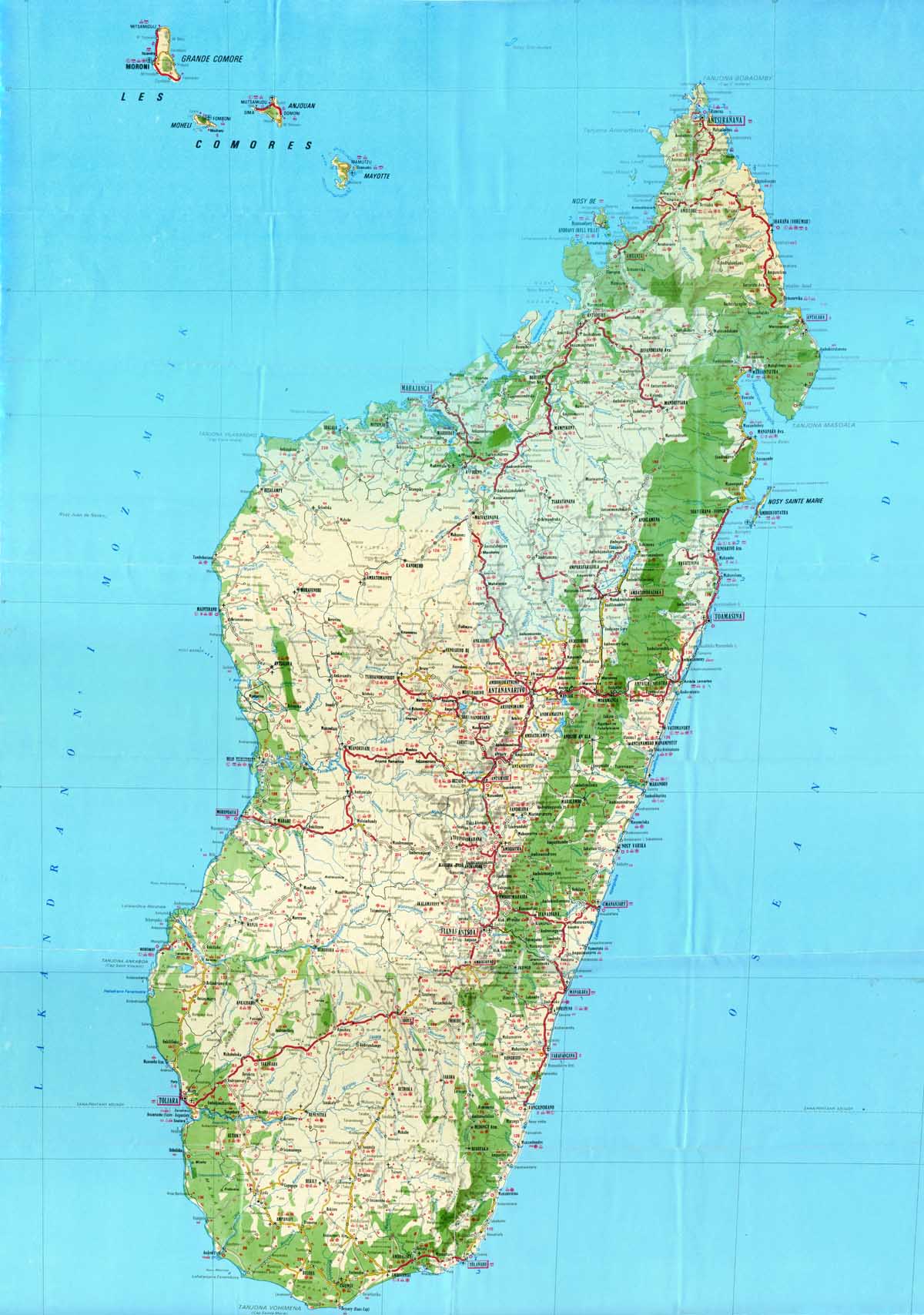
- Madagascar Map
|
-
-
-
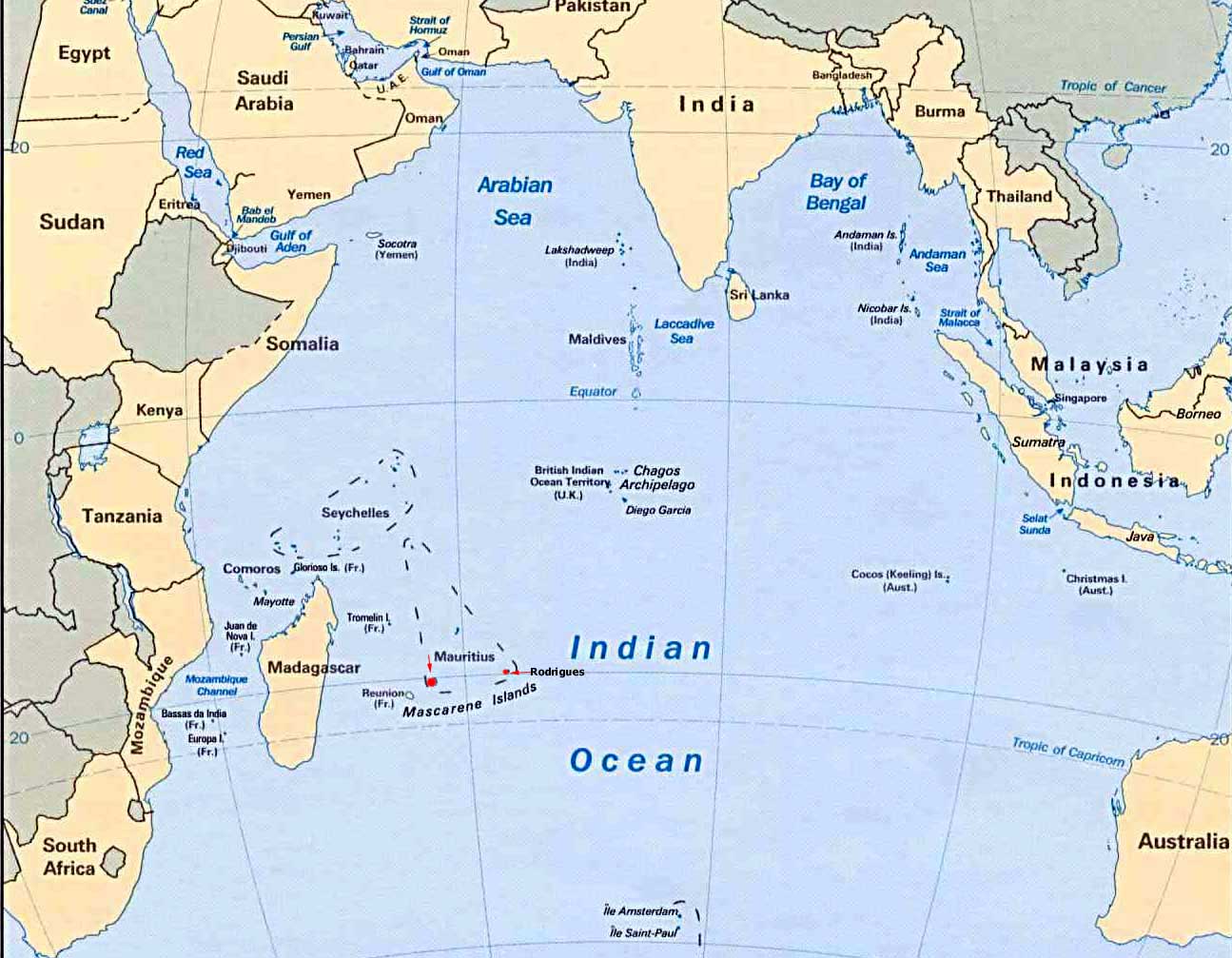
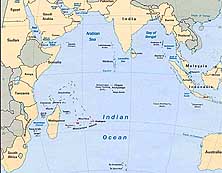
- Map of the Indian Ocean
|
|
-
|
- latest picture: October 10, 2011
|
-
- September 13th, 2011: The prop plane ATR72 of Air Austral is landing smoothly after 110
minutes at the airstrip of Tamatave (Toamasina), the port city of Eastern Madagascar.
Shortly afterwards we are at the “Visa on Arrival” desk right at the entrance.
There are no papers to fill out, we just have to pay. A three months not extendable visa
costs € 60. “We have no Euros. Can we pay also in US$?” we ask the
dark-skinned man behind the desk. With disbelief he looks at us. “Vous n’avez
pas des Euros?” (“You have no Euros?”). We shake our heads. For him it
seems hard to understand this because the airplane comes from Réunion, a Euro-country.
Only when we explain that we boarded in Mauritius and that
Réunion was only a transit stop, he consults his
conversion table. US$ 90 per person is the equivalent, he tells us. Then everything goes
straight forward and soon after we are lining up in the baggage claim area.
|
-
-
|
-
-
|
-
-
|
- 001
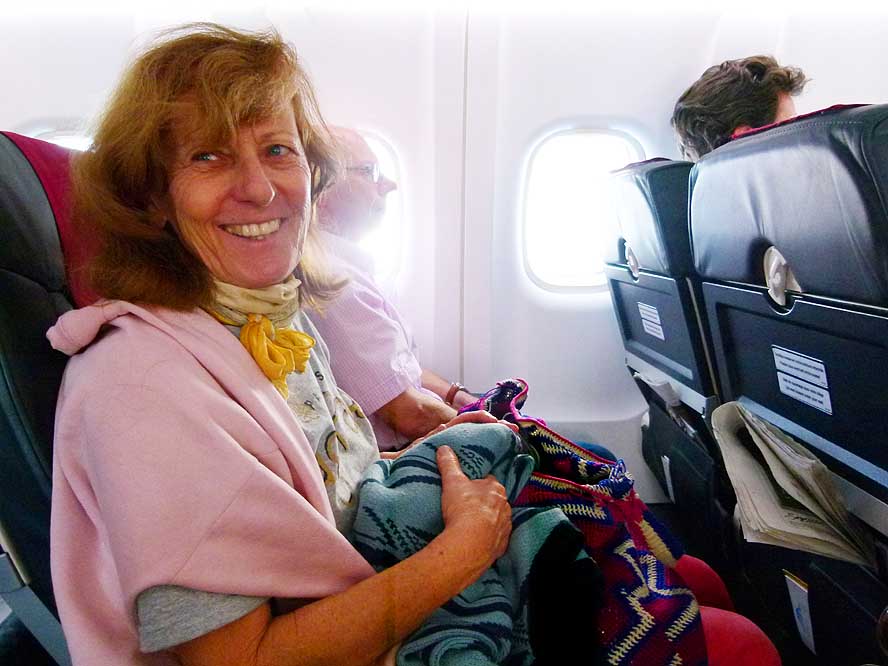
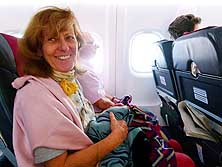
September 13th, 2011: Liliana smiles!
- We are on our way on a prop plane ATR72
- of Air Austral from Mauritius to Tamatave
- in Madagascar, the 4th biggest island in the
- world, the land of Lemurs and Baobabs
|
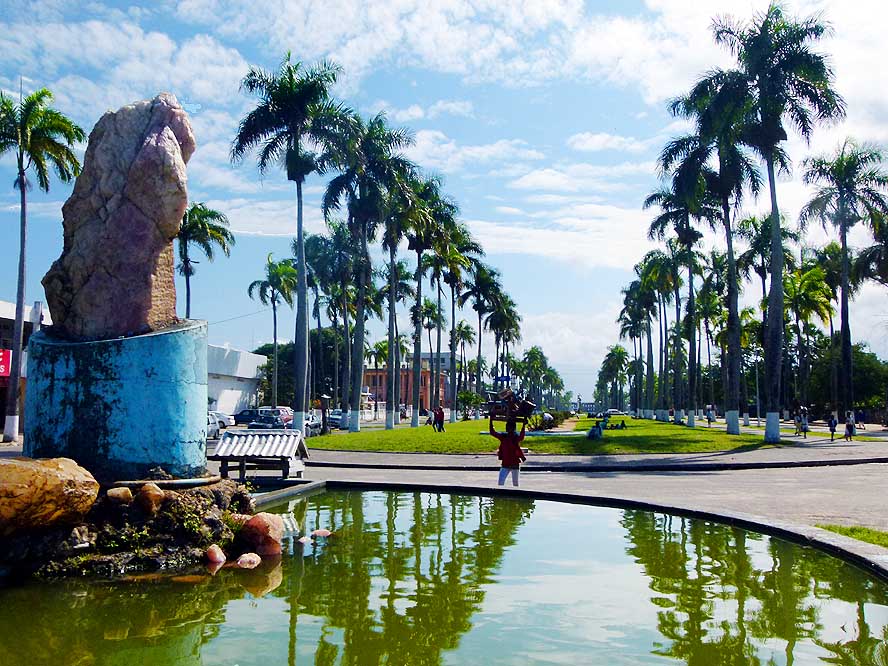
- 002
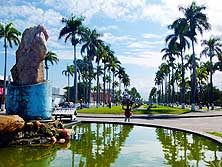
The center of the port city of
- Tamatave (Toamasina) on the East
- coast of Madagascar greets us with
- a lovely alley of palm trees
|
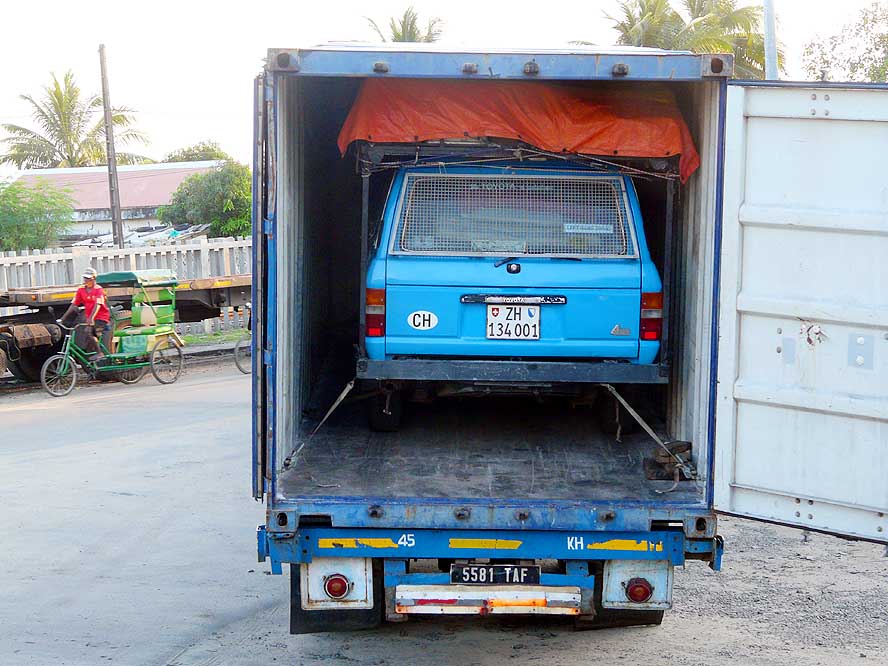
- 003
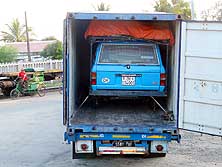
Reunion with our LandCruiser after
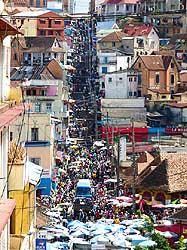
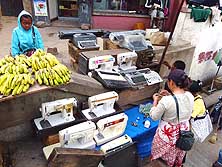
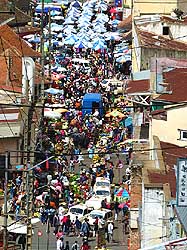
- nine days of customs bureaucracy. The
- truck with our container maneuvers to a
- platform (wall) – the only possibility to
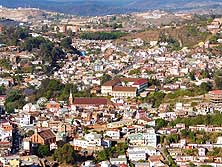
- unload our car outside of the port (within
- the harbor it’s anyway prohibited)
|
-
- There is no conveyer belt. Each luggage is handed over personally and that only after
having presented the voucher. There is no “green channel: Nothing to declare”.
Everybody has to open his suitcases and bags in front of one of the three customs officers
standing behind a long bench. Being tourists, the search of our luggage is very
rudimentary. What a delight to finally be able to step into this special corner of the
world after all the time consuming bureaucratic struggle to get a temporary admission for
our LandCruiser. Having been separated 80 millions years from the African mainland, this
island in the Indian Ocean has developed its own fauna and flora. After Greenland, Papua New Guinea and Borneo
it is the 4th biggest island of the world and measures 1’000 miles from the Northeast
to the South and 350 miles in width – enough to keep us busy for three months.
|
-
-
-
-
|
-
-
|
-
-
-
-
|
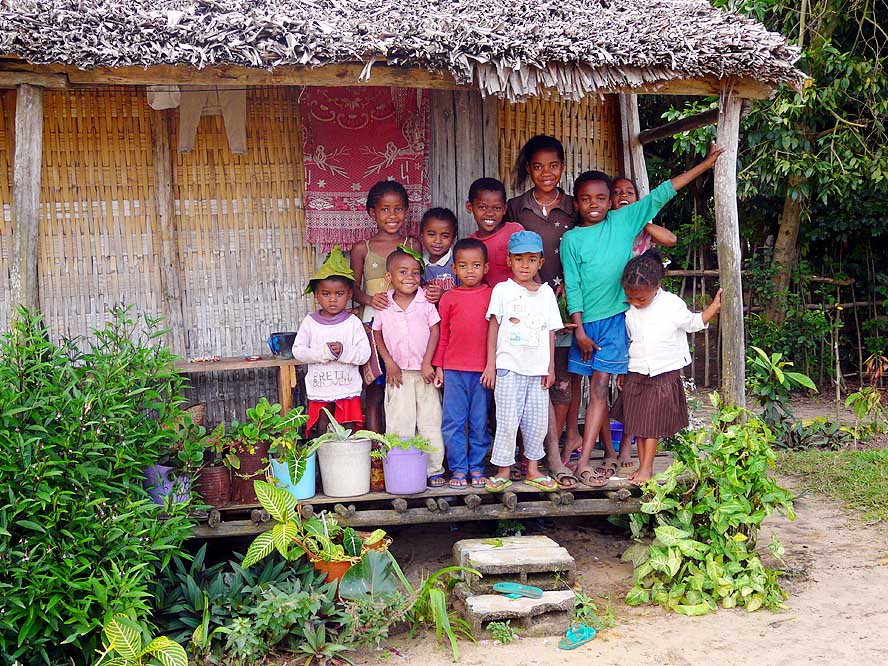
- 004
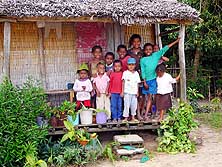
Children are posing for a picture in
- front of a modest hut with the roof made
- of leaves of the “Arbre de Voyageur“
- (Ravenala madagascariensis) – the
- “Traveler’s Tree” that grows in abundance
- in this region. Its origin is in Madagascar
|
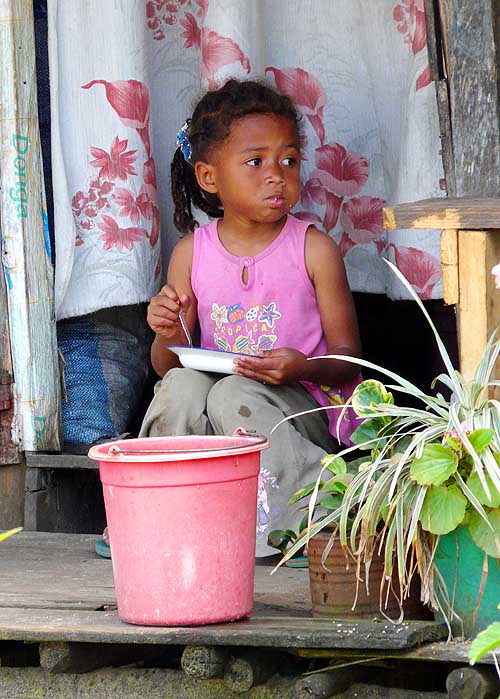
- 005
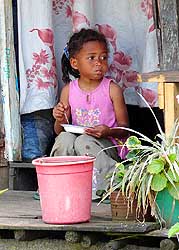
A little girl eats a bowl of rice
- in front of her hut entrance – the
- main diet of the Madagascans.
- Hunger is an alarming problem as
- the ‘Global Hunger Index’ shows
- Madagascar on place 18 (WHI 22.5)
|
- 006
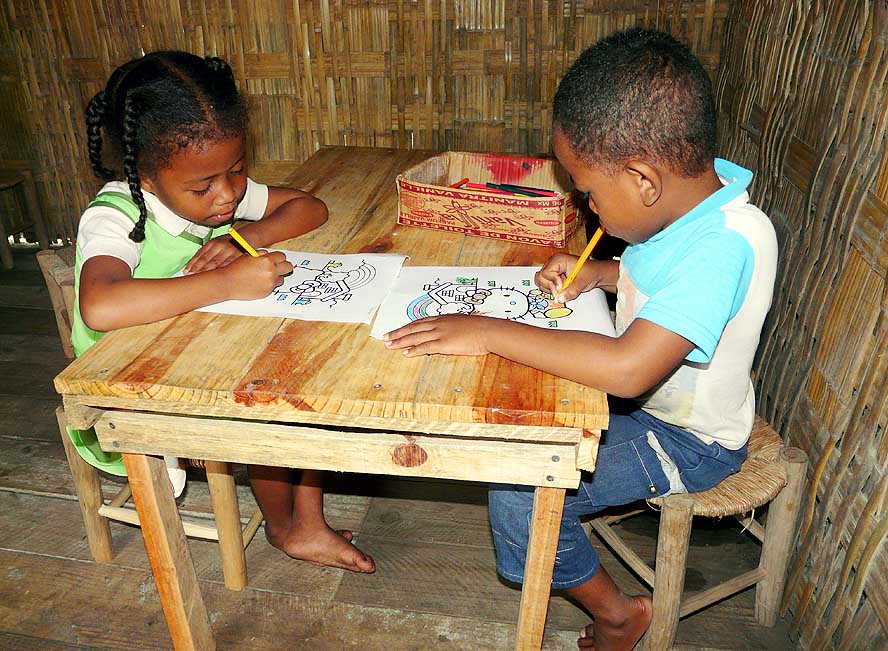
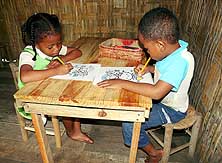
Coloring is fun. Not every child has
- this privilege. Many never learn to read
- and write because their parents cannot
- afford to pay the yearly school fee of US$
- 25 per child. The literacy rate in Mada-
- gascar stays at 70.7% (UNDP 2009)
|
-
- The son of our booked family guesthouse “Evasion” is fetching us. It is right
around the corner of the airport – a neat villa with seven rooms behind high walls
with two Madagascan radiated turtles in the garden. Our room is OK, but without a table
and chairs and without a fridge. No problem, we have everything in the car. Without
breakfast, it costs Aria 70’000 (US$35), breakfast is Aria 7’500 p.p. (US$4). In
the afternoon Serge, the migrated owner from the neighboring island of La Réunion, offers us to drive the 3 miles into town to get
money at the ATM, to buy a SIM card and to make our first contact with the broker for the
release of our car. Such an agent is compulsory and has to be officially recognized. We
land at the state-run Auximad Agency, which is simultaneously also the agent of the
shipping line Coraline.
|
-
-
|
-
-
|
-
-
|
- 007
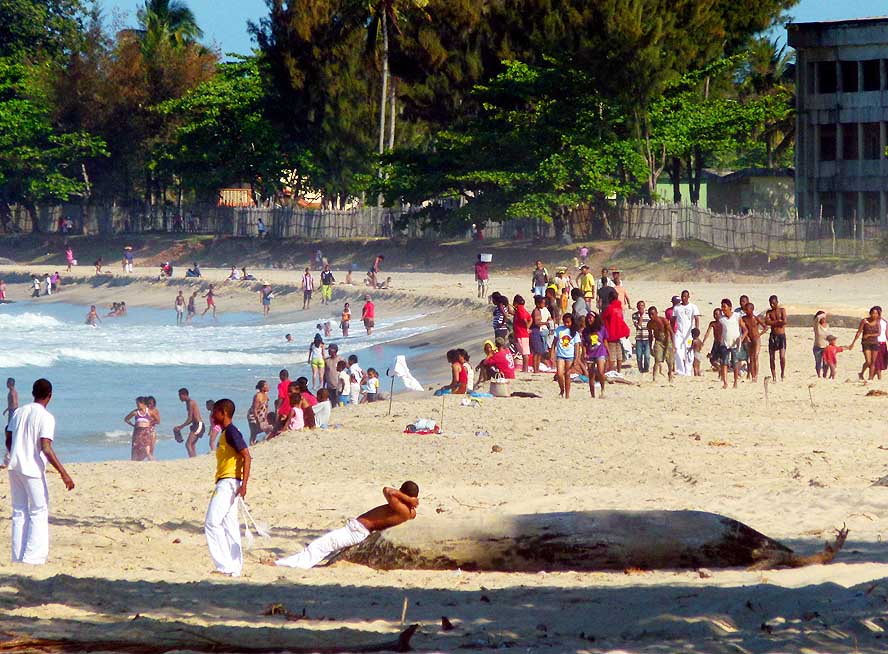
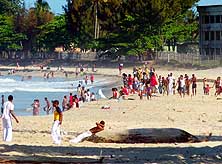
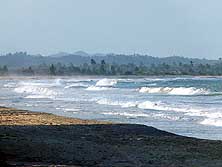
On weekends, the wide sandy
- beach of Tamatave (Toamasina) is a
- favorite gathering place for families
|
- 008
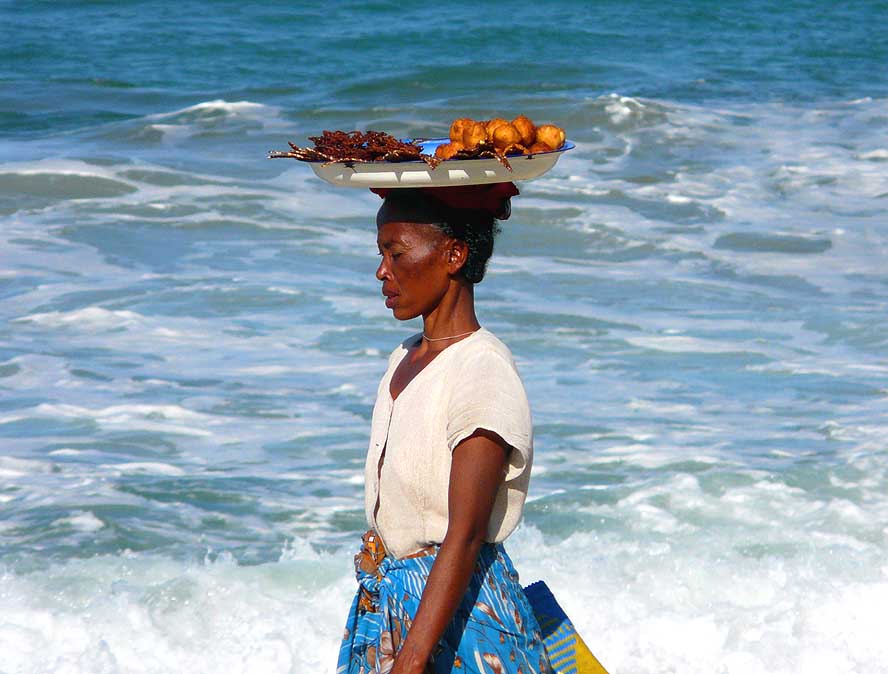
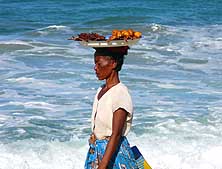
A lady street vendor walks along
- the beach of Tamatave looking for
- people buying her homemade food
|
- 009
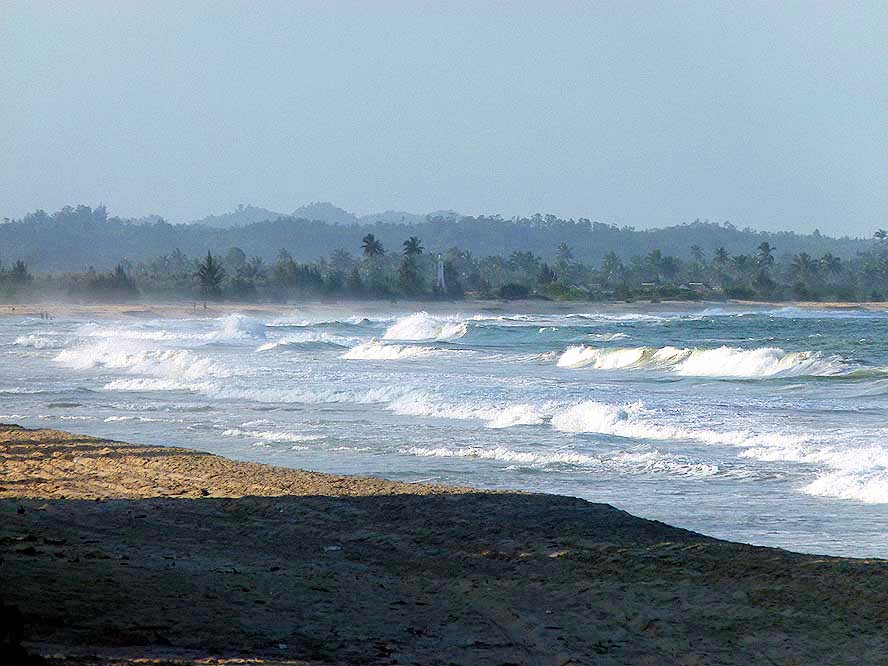
The white sandy beach of
- Tamatave stretches along
- the whole bay
|
-
- And here we go again! We are told that we need to have the original of the temporary car
admission, issued by the customs head office in the capital Antananarivo – 220 miles
away, and not an email copy sent to us to Mauritius. What
now? Soon we find out that there is only one person who can help us here in Tamatave: The
almighty “Receveur” – pretty much the boss of the regional customs place.
Our fate lies in his hands. He can decide in our favor or against it. Patiently we are
waiting in front of his office until it is our turn. A few minutes later, the problem is
solved. With his stamp and signature he transforms the copy into an original. It was that
easy! Obviously he got it that the permit for our car was approved on ministerial level.
|
-
-
-
-
|
-
-
|
-
-
-
-
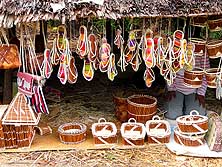
|
- 010
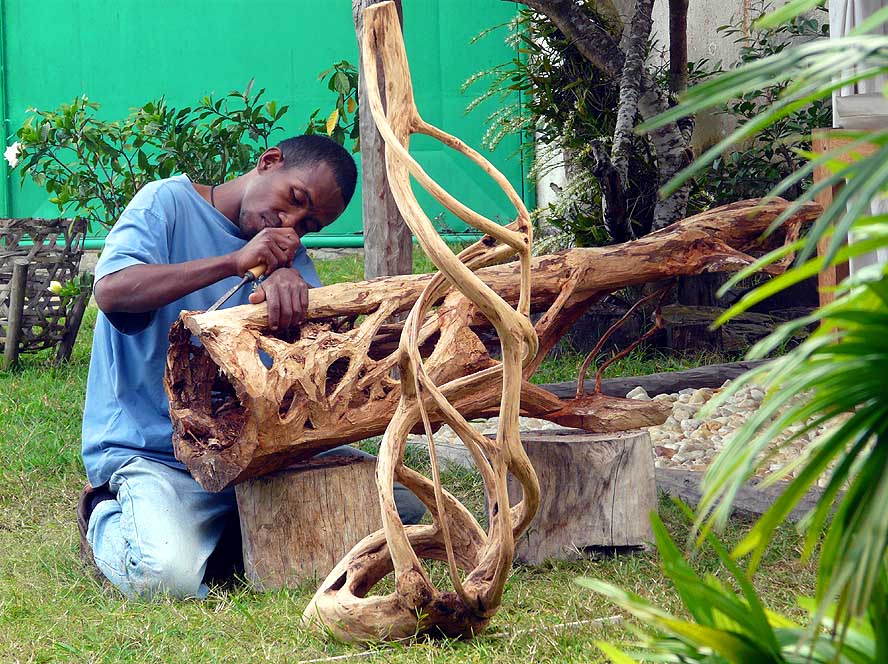
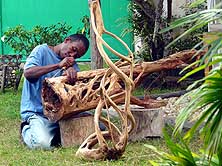
An artisan is carving an artful
- decorative structure from a root
- of a “strangler fig tree”
|
- 011
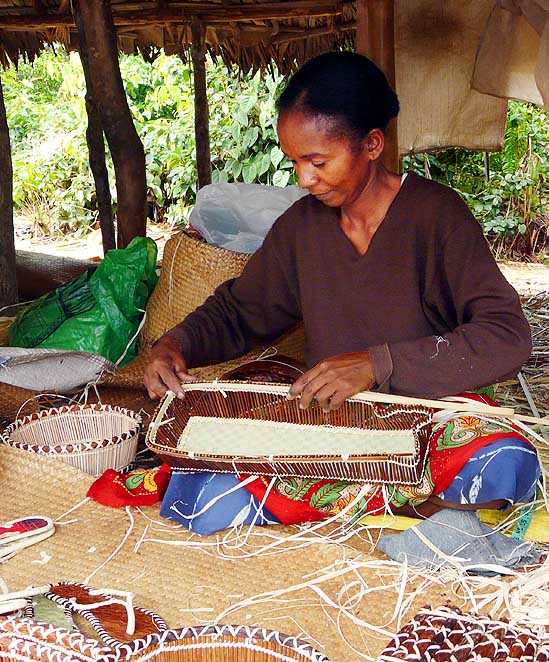
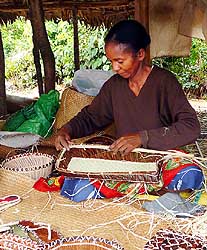
A lady artisan works on a basket
- with plants of the region. The bottom is
- made of leaves of the “Arbre des
- Voyageurs“, the “traveler’s tree”; the
- walls are made from the Raffia palm
|
- 012
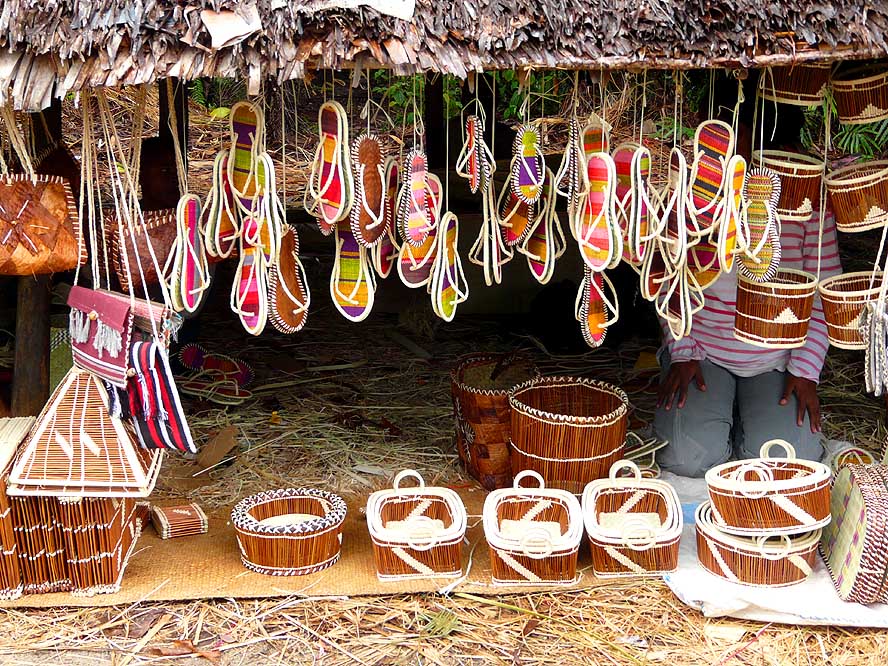
Handmade decorative sandals
- and baskets at a craft center along
- the road North of Tamatave
|
-
- If we thought that everything would work smoothly now, we are completely wrong. Nothing
is moving anymore. Day by day goes by and we make no headway. Somebody is being
deliberately obstructive. Probably they want to put so much strain on us until we are
ready for bribes. Only a call from our Embassy on September 22nd, gets the ball rolling
again. So, on Friday, September 23rd, – after nine days! – we are waiting from
11am for hours at “Alain’s place” at the dusty harbor road for the truck
with our container to arrive. It’s a kind of a platform where a lorry can back up to
unload its cargo. But nothing happens! And every time we phone to Auximad to inquire about
it, we are told: “In half an hour”.
|
-
-
|
-
-
|
-
-
|
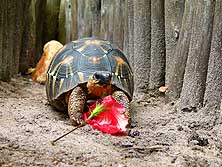
- 013
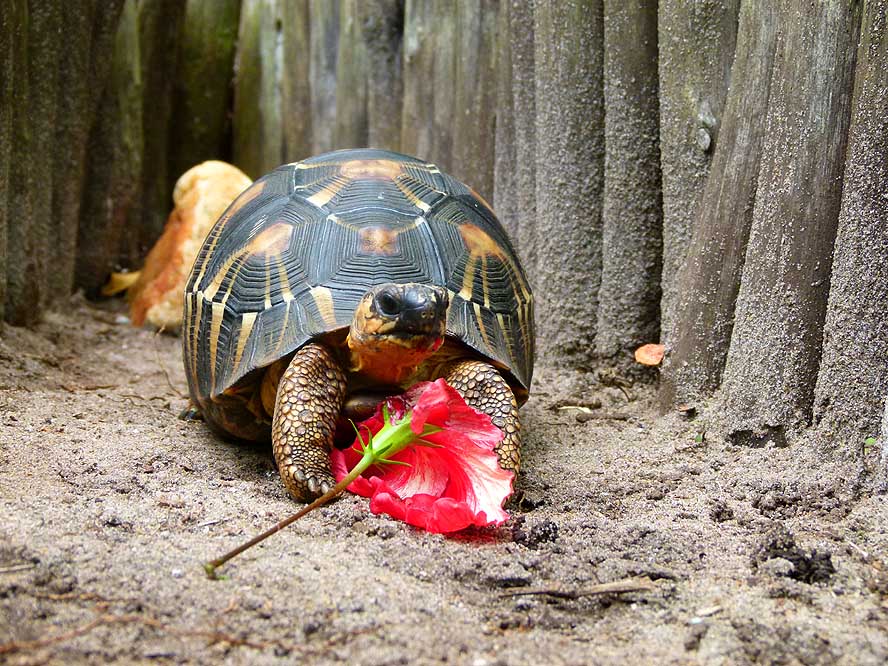
The radiated tortoise (Astrochelys
- radiata) with its striking drawing prefers
- hibiscus flowers to salad. It can weigh
- up to 33 pounds. It is classified as
- “critically
endangered” (CITES)
|
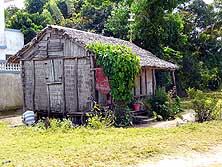
- 014
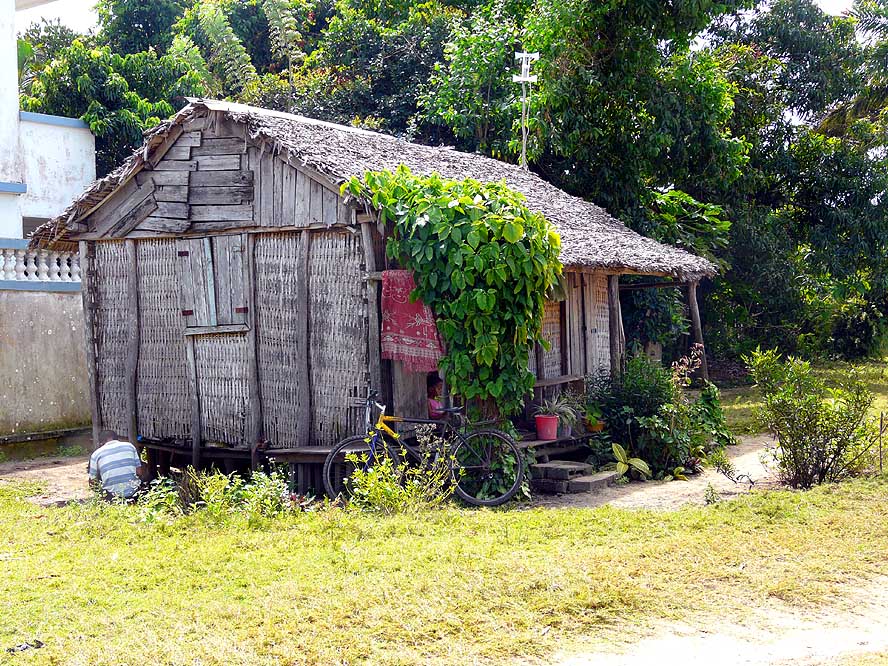
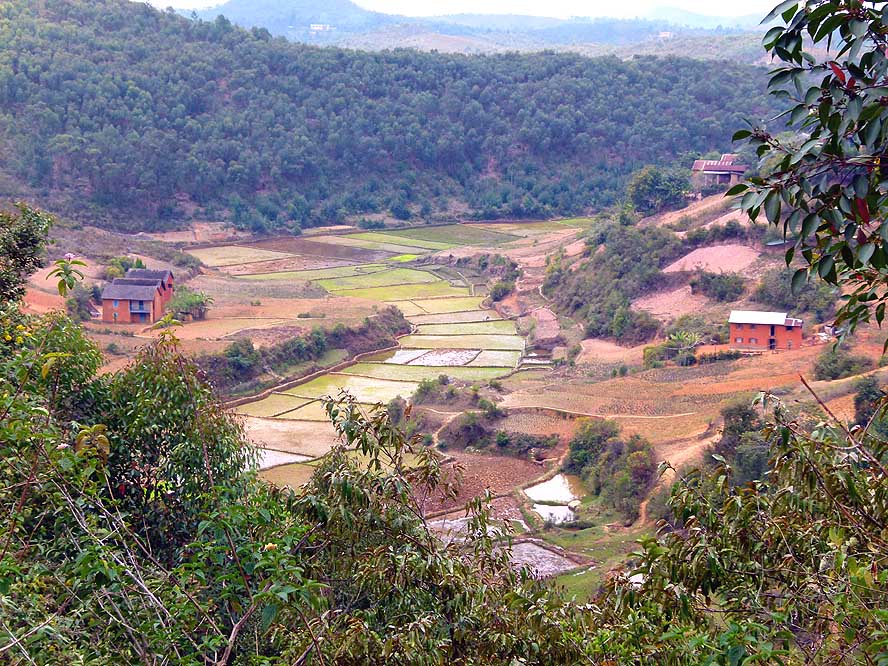
A typical dwelling of the coastal
- region of Tamatave. The roof is
- covered with leaves of the “Arbre
- des Voyageurs“, the “traveler’s tree“
|
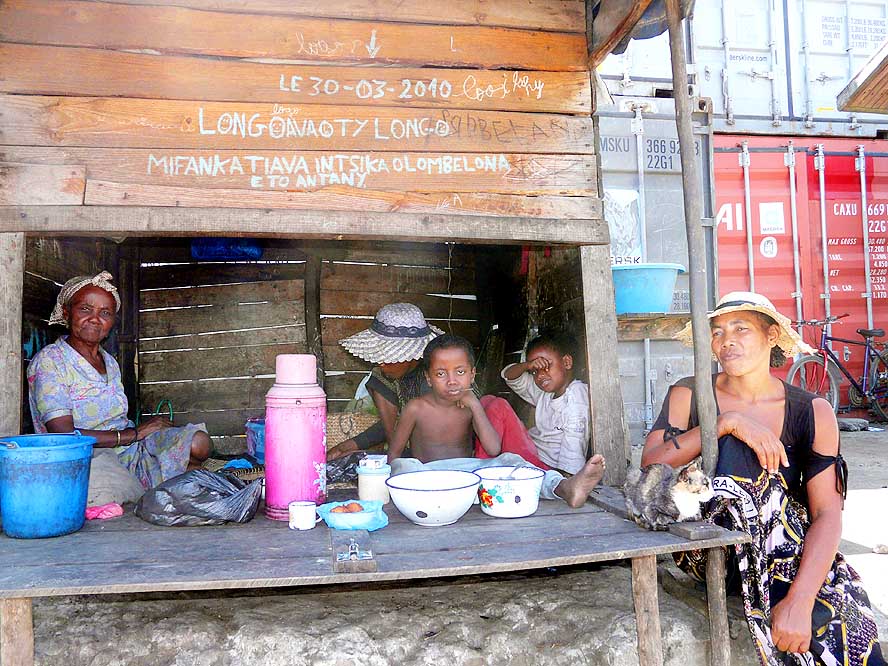
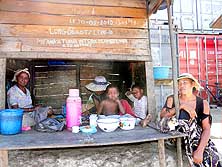
- 015
A simple street eatery in Tamatave’s
- port region. There is hot coffee, peanuts,
- biscuits and some homemade food
|
-
- When at 4pm the responsible has switched his phone to “voice mail” and we are
not able to reach him anymore, we have had enough. We ask Alain for advice what to do.
When he hears the whole delaying story, he gets really upset too: “This is not the
way how to treat foreign customers” he repeatedly exclaims. He waves us into his car
and drives us immediately to Auximad. As soon as “our” man behind his desk
realizes who we are with (until that moment we did not know that he is the President of
the National Heavy Traffic Department), he speaks excitedly into his phone. “The
container is now on its way” he tells us much to our surprise. At the same
time he submits us all the customs and port papers.
|
-
-
|
-
-
|
-
-
|
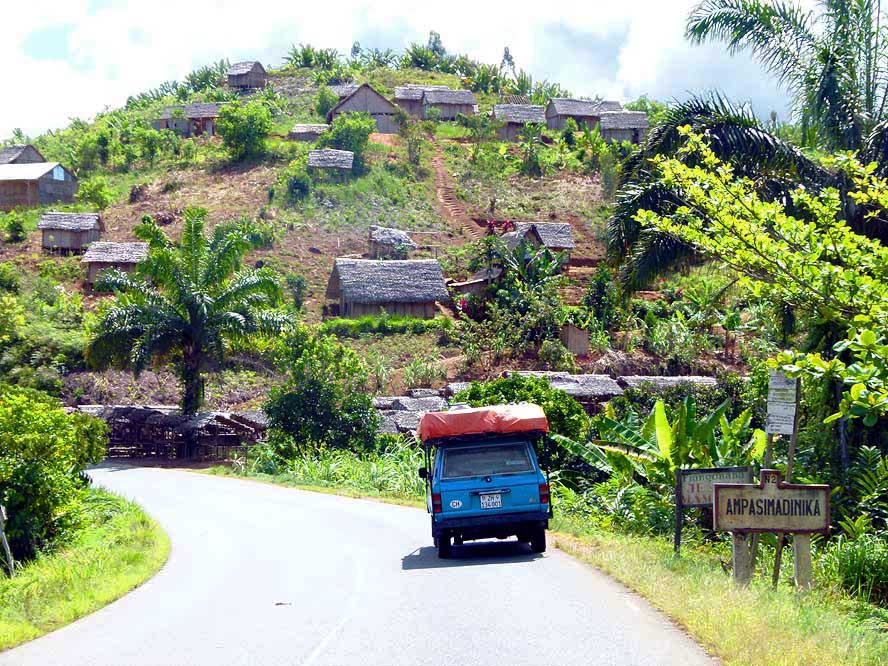
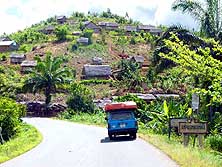
- 016
On the road, direction South. We
- pass a thatched village with a hardly
- pronounceable name. Like this one,
- a big part begins with the letter A
|
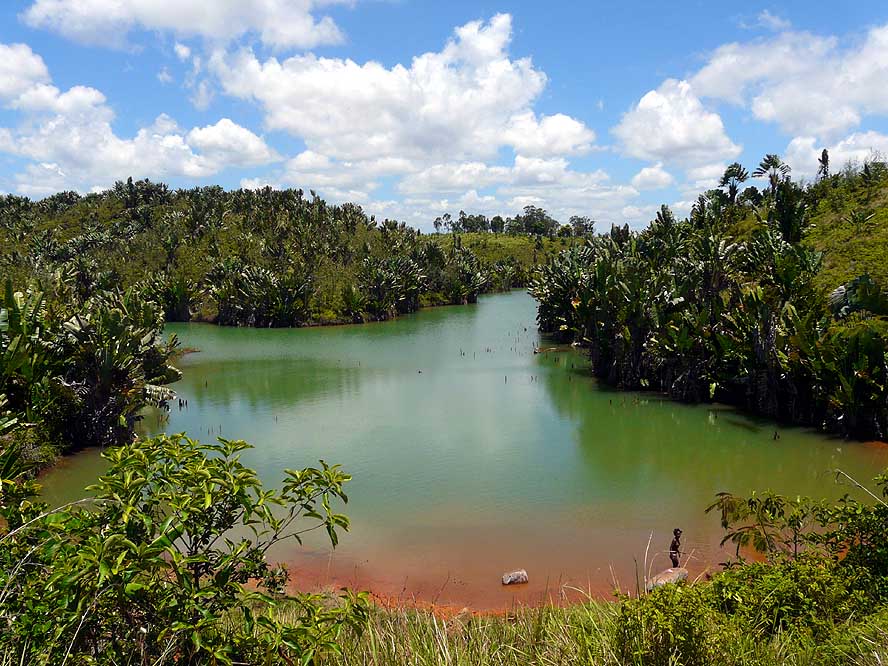
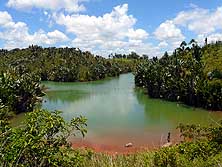
- 017
A pond, surrounded by lush
- tropical vegetation, is a lovely sight on
- our way to the highlands of Andasibe
|
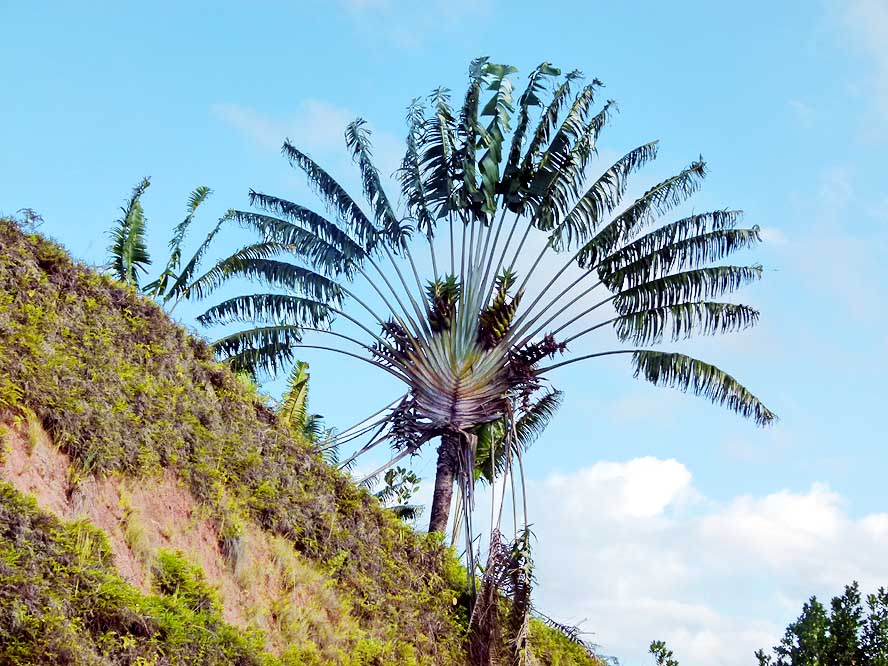
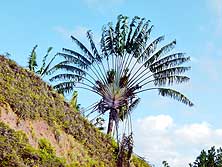
- 018 A
widespread palm in the East: The
- fanlike “Traveler’s Tree” (Ravenala
- madagascariensis) that got its name
- from its capacity to store water,
- quenching the travelers thirst
|
-
- Alain, our “savior” drives us immediately to the port where the gate opens
automatically for him. What a miracle one person can achieve if it’s the right one!
The truck with our LandCruiser is already approaching us, and shortly after it arrives at
“Alain’s place”. Immediately we are surrounded by “helping hands”
who all argue about the best way to drive the LandCruiser out of the container to the
platform. “No, it does not work like that”, we shout horrified when they
maneuver the truck too far away from the platform and want our 4-ton vehicle to balance
backwards on two rotten planks to safe ground. ”Let’s try again”, we
suggest. This time, the driver manages to back up completely to the platform and in no
time our LandCruiser in on Madagascan soil. Everybody is happy and of course everybody
expects some money.
|
-
-
|
-
-
|
-
-
|
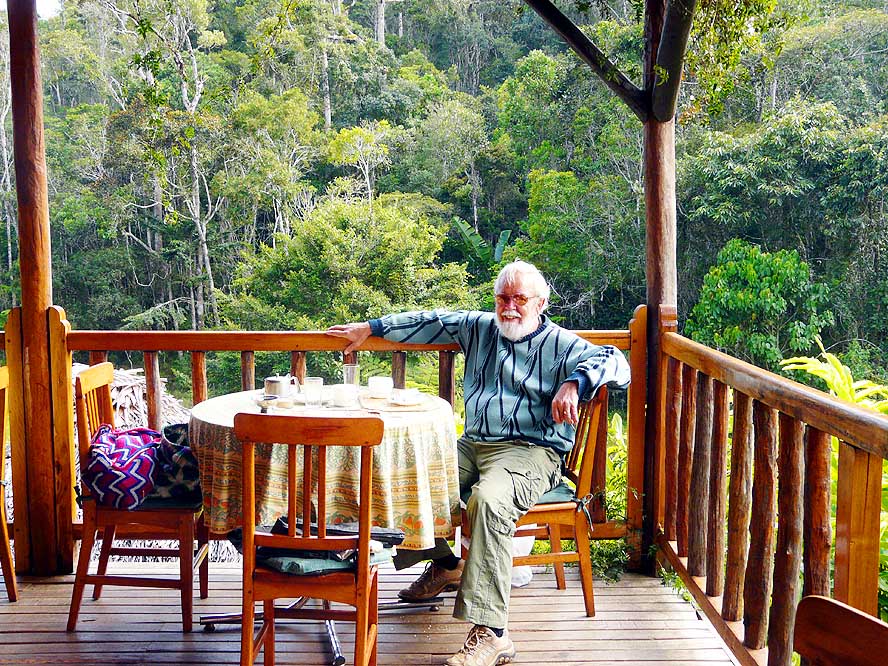
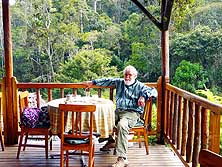
- 019
Emil enjoys breakfast at the lovely
- setting of the Hotel ‘Feon‘ny Ala’ in
- Andasibe. It borders the National
- Park of Mantadia …..
|
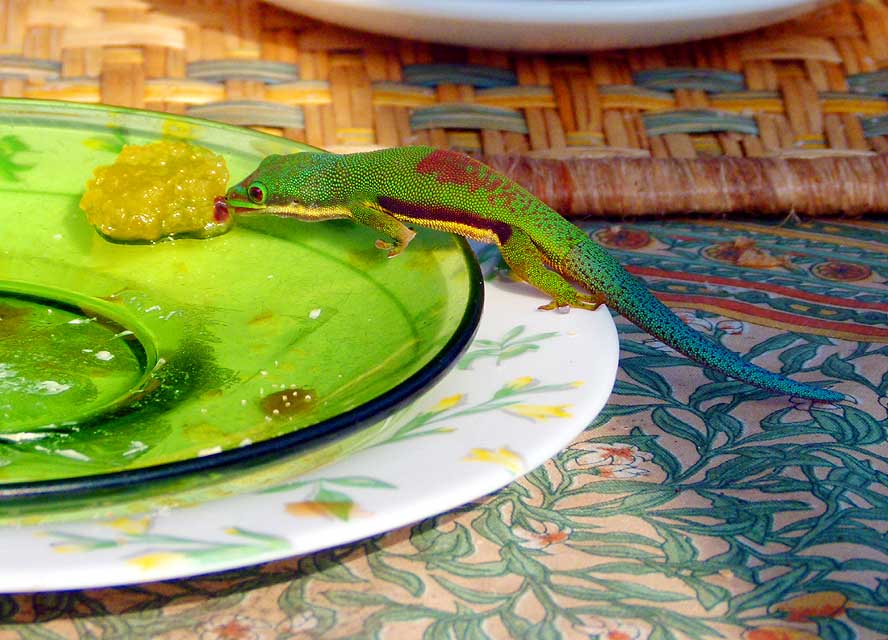
- 020
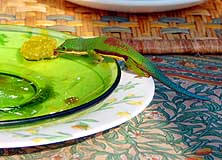
….. visitor at breakfast: A colorful
- lizard licking our marmalade. The
- craving for sweet is bigger than the fear!
|
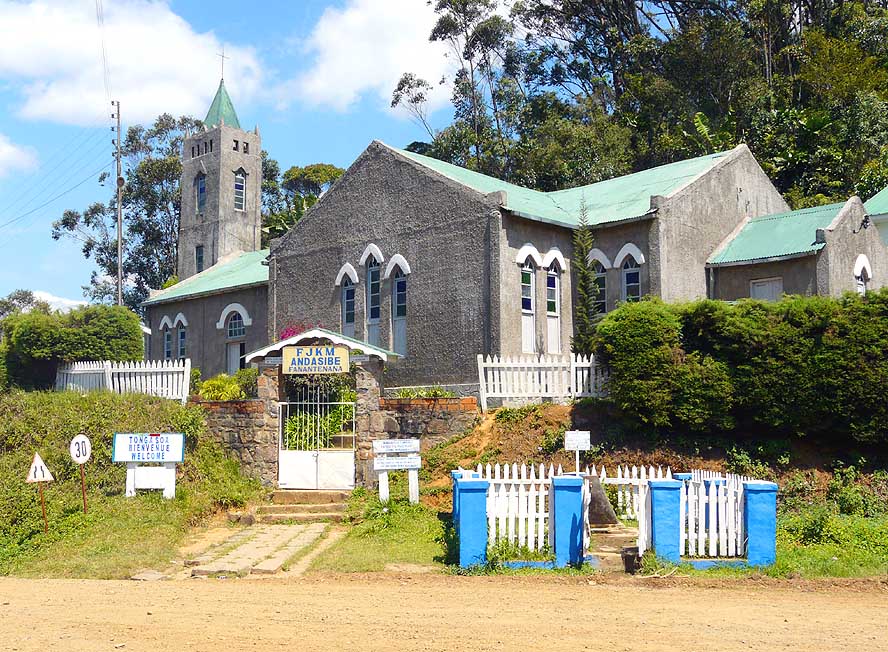
- 021
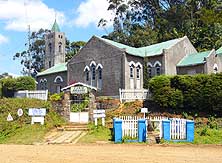
The FJKM village church – Church
- of Jesus Christ – in Andasibe is a monu-
- mental building compared to the modest
- village. This congregation is quite
- widespread in Madagascar
|
-
- The sky is already getting pink colored when we roll with our LandCruiser through the
roads of this port city three miles to the North to our accommodation. What a different
life compared to Mauritius, our last destination. Here the
colorful high wheeled bicycle rickshaws and those drawn by hand dominate the scene. Women
carry pots, gaskets, bags etc. on their heads – everything has an unmistakable
African touch, despite that the Madagascans do not see themselves as Africans, but as
islanders. Tamatave with its potholed streets and fading facades of colonial houses is not
a feast for the eyes. But the city has a lovely palm-fringed avenue and somehow we have
the feeling to be able to breathe more easily here than in many other big cities. The
narrowness of the streets, the confining crowd of people is missing.
|
-
-
|
-
-
|
-
-
|
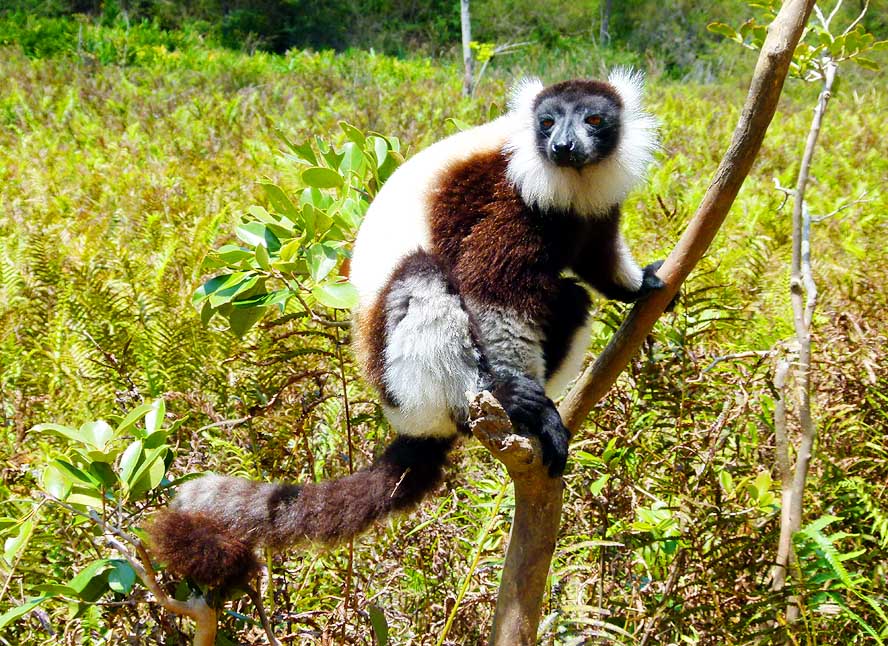
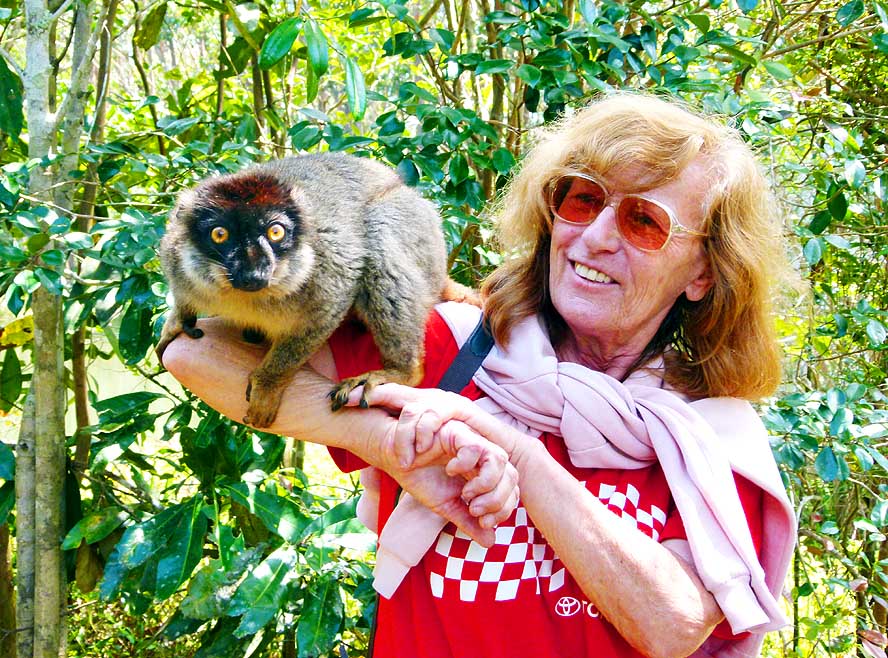
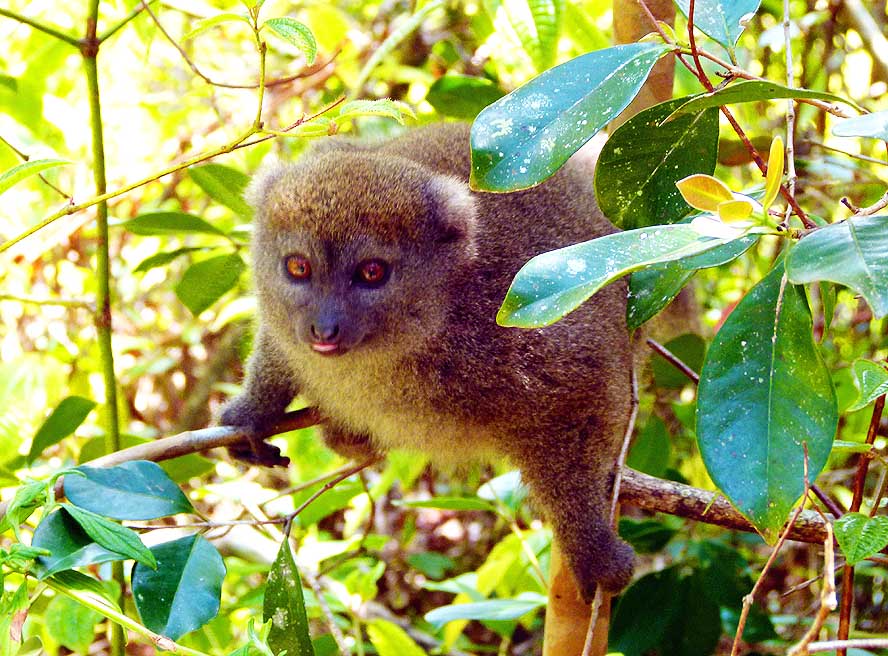
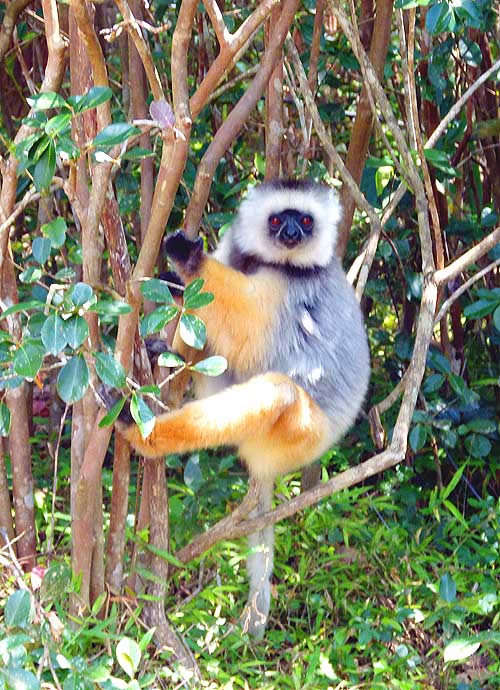
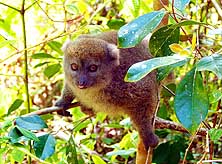
- Our first encounter with hand-tame lemurs at the Vakona Forest Lodge Sanctuary near
Andasibe
|
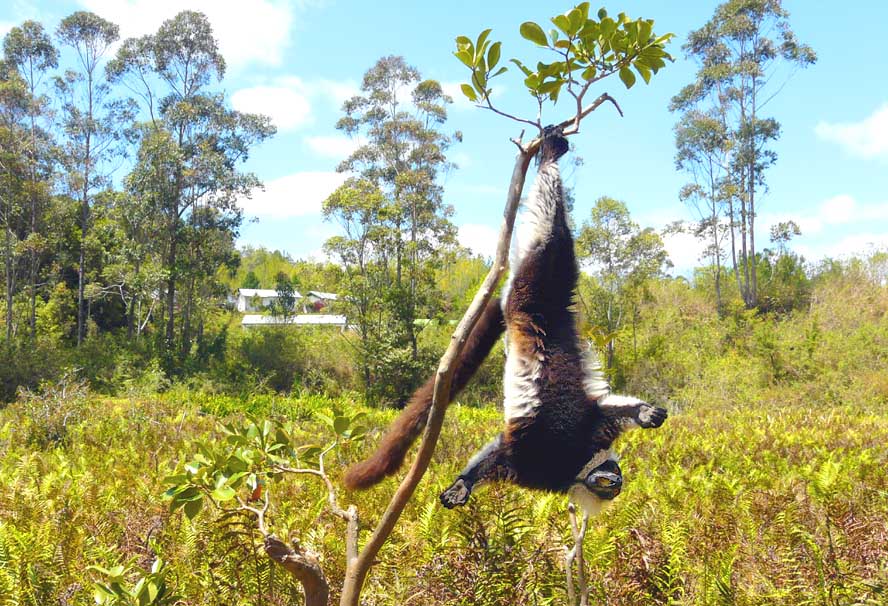
- 022
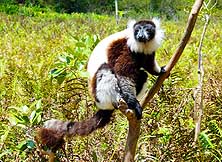
The Black-and-White Ruffed
- Lemur (Varecia variegate) is
- critically
endangered. Characteristic
- is its dog like snout
|
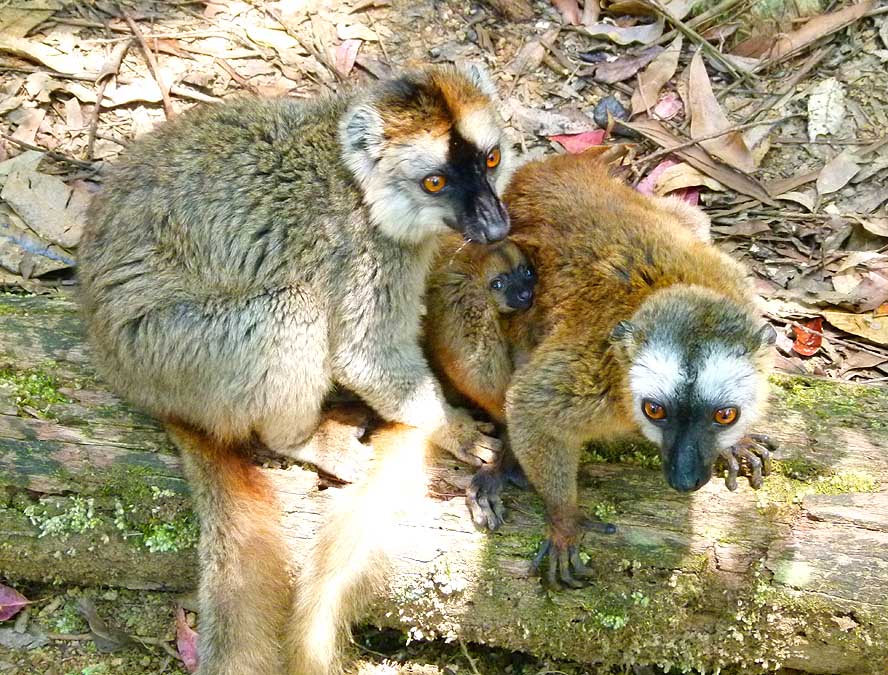
- 023
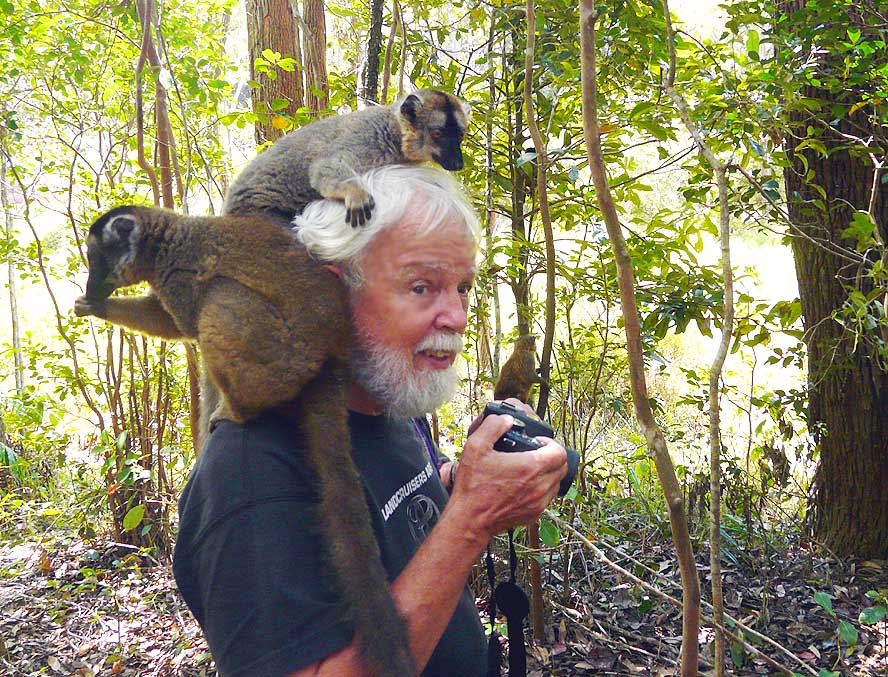
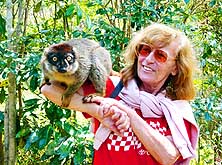
Without warning, this Common
- Brown Lemur (Eulemur fulvus)
- jumps on Liliana’s shoulder.
- It is active day and night
|
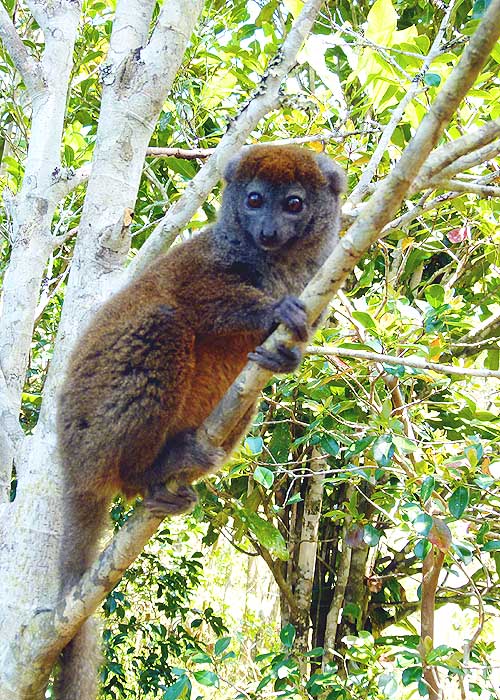
- 024
An adorable offspring of
- the Lesser Bamboo Lemur (or gentle
- lemur) (Hapalemur griseus) looks
- a bit clumsy through the foliage
|
-
- We hardly reach our guesthouse when I feel miserable. Two hours later, the temperature
has risen to 102.4°F. Because apart from shivers I have no pains, we are pretty sure that
I caught malaria. It happened the same way in 2010 shortly after our arrival in Papua New Guinea, and there it was diagnosed malaria. A quick
test at the Medical Service in town shows a negative result. “It might still be too
early to be detected” means Judith, the lady doctor. Therefore, we wait another day.
The night is terrible; only the many “Panadol” tablets keep my fever below the
104°F limit. Two days later we make another malaria test; once more it is negative. But
then I am racked with stabbing chest pains while breathing. There is no doubt now: It is
pneumonia once more – by the way my 8th since 2008 – not really motivating for
my up-coming 70th birthday tomorrow. My birthday wish to spot my first lemurs on my
special day will therefore not come true. This will have definitively to wait.
|
-
-
|
-
-
|
-
-
|
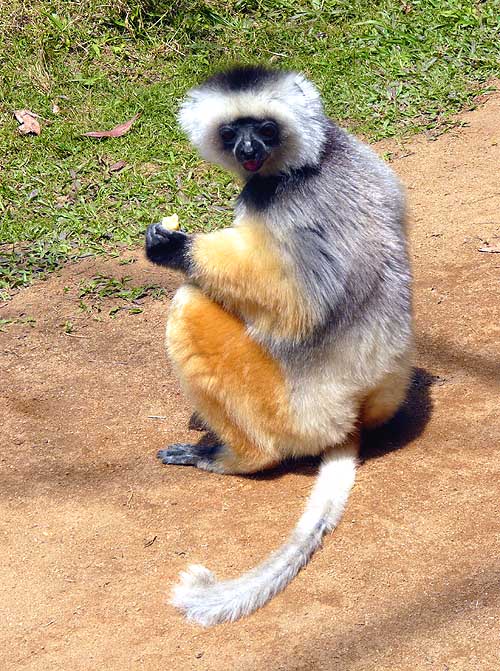
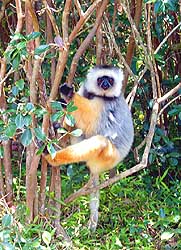
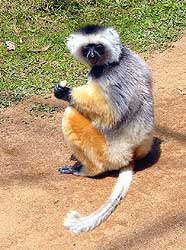
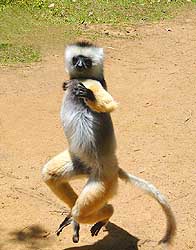
- The Diademed Sifakas (Propithecus diadema) are big entertainers (though they
belong to the endangered
species).
- They move on their hind legs with arms aloft and can dance like ballet performers:
|
- 025
“These two tourists seem
- really to like me?” …..
|
- 026
….. “for a small piece of banana, I
- am also ready to pose for a picture!” …..
|
- 027
….. “Watch-out: I give
- you a little performance!”
|
-
- With email support and advice of our “family” doctor in Kuala Lumpur in Malaysia, we start self-treatment with antibiotics. The medical
care is anyway not at its best in Madagascar. Expats and those who can afford it fly out
in such an emergency to the neighbor island of Réunion.
Since Tonga, where I nearly lost my leg due to the lousy
treatment of my dog bite, we have little confidence in hospitals and doctors of third
world countries. Emil is visiting some pharmacies and asks them what antibiotics they have
on sale. The result is transmitted immediately to our doctor who recommends two of them.
Within a week we are finally able to hit the road with much anticipated joy.
|
-
-
-
-
|
-
-
|
-
-
-
-
|
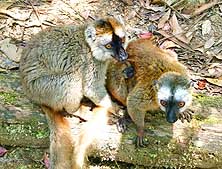
- 028
Much cared of by its parents, this
- tiny Common Brown Lemur baby
- (Eulemur fulvus) looks confidently out of
- her mother’s belly fur (there’s no pouch)
|
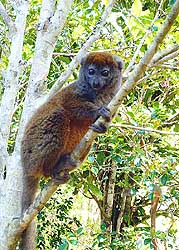
- 029
A young Lesser Bamboo
- Lemur (Hapalemur griseus) surveys
- curiously from its tree “look-out”
|
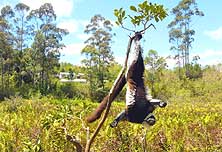
- 030
The Black-and-White Ruffed
- Lemur (Varecia variegate) wants
- to show us how smart it is
|
-
- Tamatave-Andasibe = 132 miles; 5.7 hours
It is a glorious feeling to be on the road again. Through the confusion of bicycle
rickshaws and street markets we leave the port city of Tamatave behind us and head South.
For a long time we are driving past the modest thatched huts made from the leaves of the
“Arbre du Voyageur” – the “Traveler’s Tree” – that are
typical of this region; eucalyptus trees are following. Then, towards the highlands, it
changes into barren, deforested hills, slash-and-burn areas and simple villages. Shortly
before dusk, we reach the village of Andasibe and are lucky to find the last free bungalow
at the Hotel Feon’ny Ala, beautifully situated at the edge of the National Park of
Mantadia. We are in very good spirit. Today on our first driving day we made 132 miles in
5.7 hours, passed four checkpoints of police and military and all of them were friendly
and correct. Our nervousness about corruption eases and our worries are disappearing.
|
-
-
|
-
-
|
-
-
|
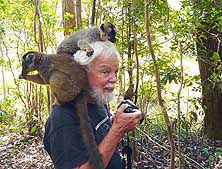
- 031
How can pictures still be taken?
- Two bold Common Brown Lemurs
- (Eulemur fulvus) jump without
- warning on Emil’s head and shoulder
- and make themselves comfortable
|
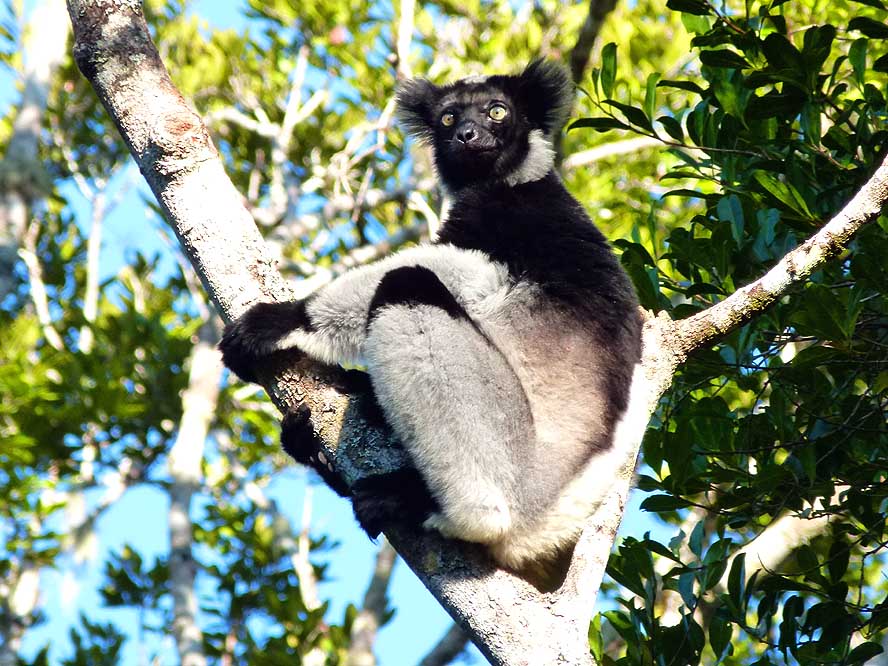
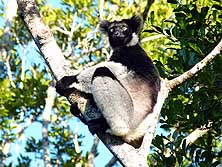
- 032
“Indri-Indri” – Indri the king of the
- lemurs – is to be found only in the National
- Park of Andasibe-Mantadia. With its length
- of up to 3 ft. it is (still) the largest of living
- lemurs. Its territorial calls can be heard
- as far as 2 miles away .....
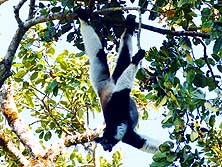
|
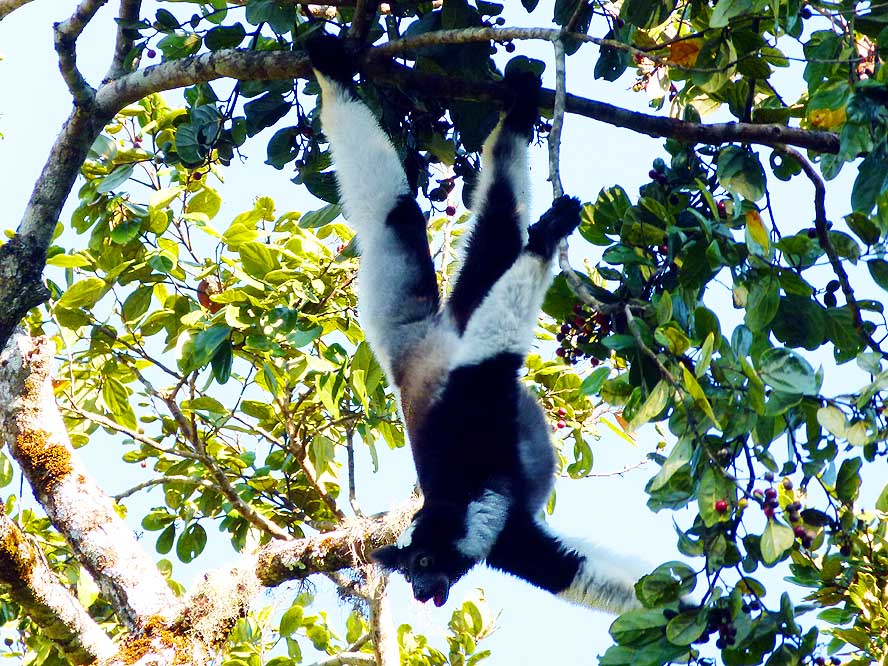
- 033
….. it can leap up to over 30 ft.
- between tree trunks. It is foraging for
- leaves – it eats at least 4 pounds a day –
- and spends hours of resting afterwards.
|
-
- Andasibe is the place we chose to celebrate my belated milestone birthday. The lovely
Vakona Lodge with its own small lake seems to be the right frame – you get 70 only
once! But it comes differently! It is not because of the price of US$ 100 a night –
we would for once be prepared to accept it – no, I simply do not like the atmosphere.
I find the glass palace too sterile; I feel out of place. “Fancy-shmancy” in the
jungle is not my taste, not even for a special birthday marking a decade.
|
-
-
|
-
-
-
-
|
-
-
|
- At the “zoo” of the Vakona Forest Sanctuary near Andasibe
|
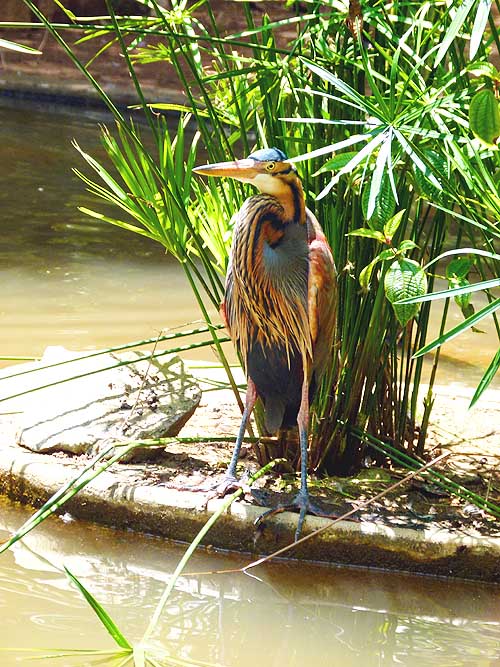
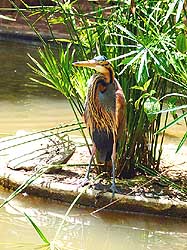
- 034
A beautiful Purple Heron
- (Ardea purpurea) stands
- motionless in its territory …..
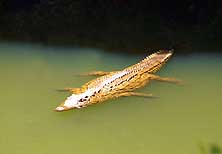
|
- 035
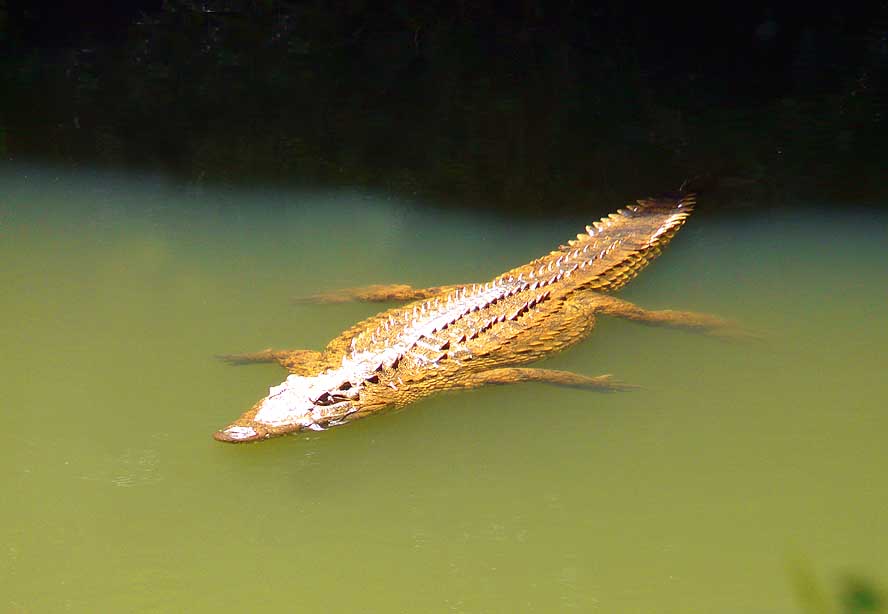
….. a crocodile glides
- soundlessly through the water
|
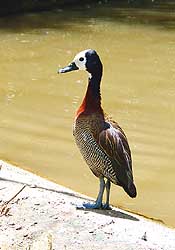
- 036
….. a white-faced whistling
- duck (Dendrocygna viduata) shares
- its territory with the Purple Heron
|
-
- Despite of that it turns out to be a beautiful and unforgettable day for me. In the
morning, I encounter my very first lemurs – five species, hand-tame though, but
therefore from very close (the guards feed them with bananas that they are always
around!). They live in the small open park belonging to the Vakona Lodge (entry fee Aria
12’500 each = US$ 6). It is just heart-warming how they immediately hop towards us. A
big entertainer is especially the light footed “Diadem Sifaka” that moves
sideways on its hind legs with arms aloft and performs like a dancer. But also the
youngsters of the “Common Brown Lemurs” play their game: Without warning, one is
jumping on my shoulder and two others are choosing Emil as a “tree”. One clings
at his head and the other makes it comfortable on his shoulder. Through the foliage a
clumsy offspring of the “Lesser Bamboo Lemur” is watching the happening. A tiny
one months old baby looks confidently out of its mother’s belly fur (there is no
pouch) – memories that will stay with us for ever.
|
-
-
|
-
-
|
-
-
|
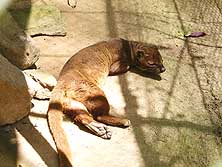
- 037
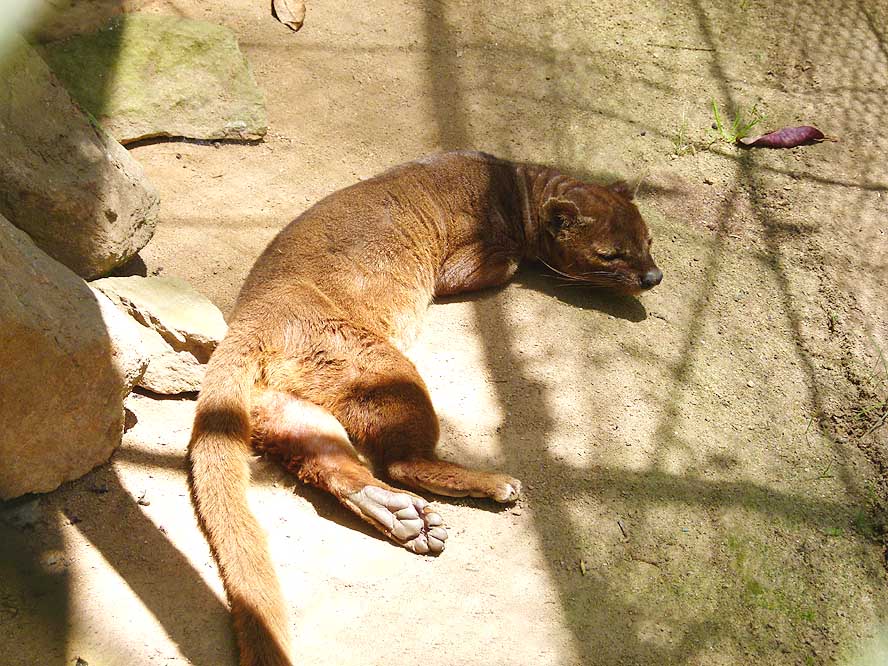
The catlike “Fossa” (Cryptoprocta
- ferox) is a predator endemic to Mada-
- gascar. It feeds mainly on lemurs, is a
- good climber and is known to follow
- lemur families for days and surprise
- them at night in their sleep on the trees
|
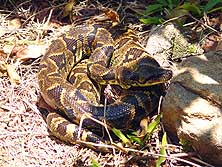
- 038
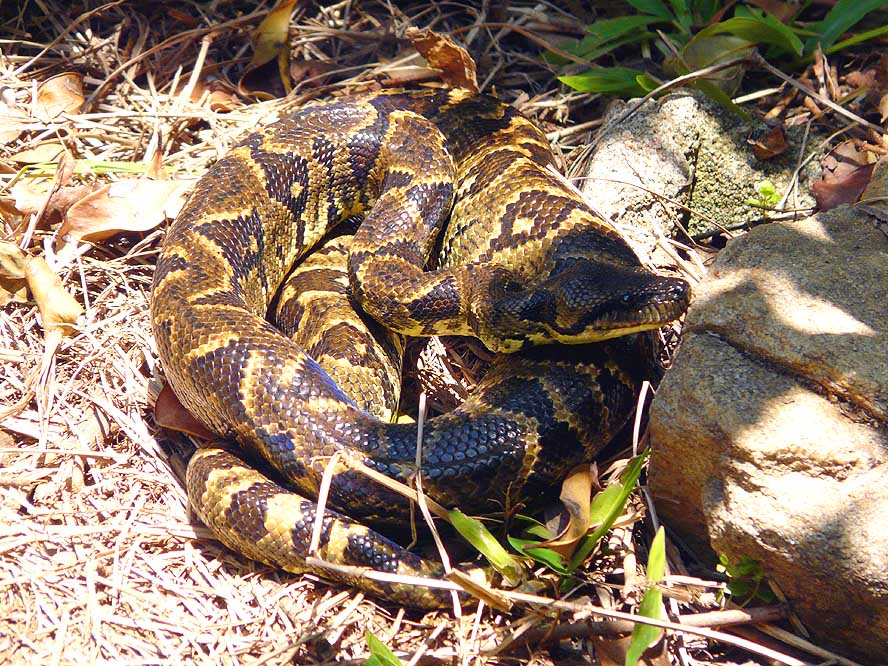
A Madagascar Tree Boa (Boa
- manditra) in the small zoo of the Vakona
- Forest Lodge near Andasibe. Its length
- can reach up to 7 ft. It lives all over the
- island, but mainly in the rainforest. There
- are no poisonous snakes in Madagascar
|
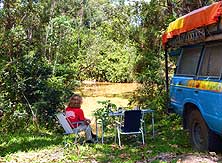
- 039
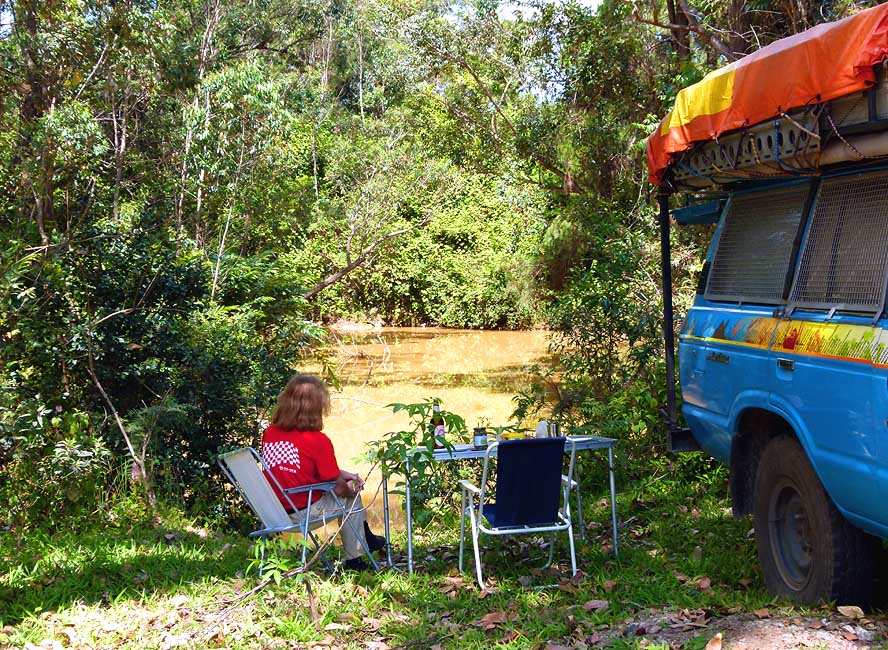
Just how we like it: A peaceful
- picnic at the lovely Vohitra jungle
- river near Andasibe
|
-
- At noon, we find an idyllic picnic spot along a brown, lazily running jungle river
– exactly how we love it. And in the evening – as the culmination of my 70th
celebration – an “Indri Sifaka” family appears high up on the treetops at
the edge of the Mantadia National Park. “Indri’s” are the tallest still
living lemurs in Madagascar, are endangered and are to be found only in this and the adjacent
Analmazaotra Reserve. From our bungalow at the Hotel Feon’ny Ala that is bordering
the national park, we hear the “melancholic” call of these primates, marking
their territories. It echoes up to two miles through the forest. What a wonderful
experience!
|
-
-
|
-
-
|
-
-
|
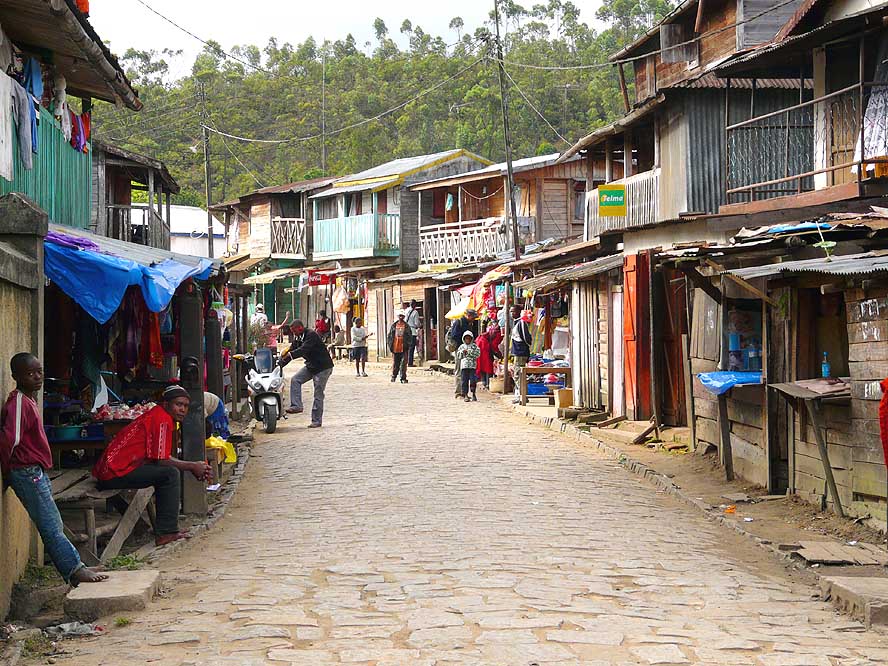
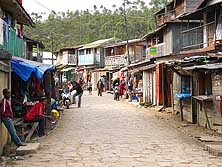
- 040
Where life is still peaceful: The
- tiny village of Andasibe, lying on an
- altitude of 3’000 ft. – situated about
- halfway between the port of Tamatave
- and the capital Antananarivo
|
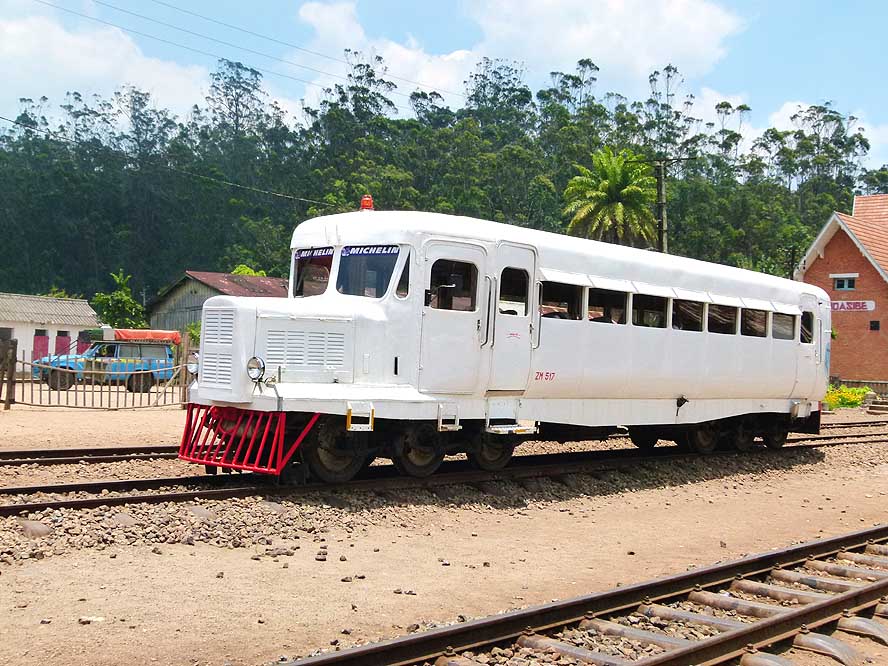
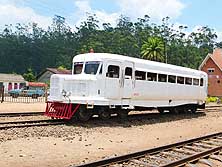
- 041
“The “Michelin train” (La Micheline)
- is the rarest train in the world. The only
- one left runs still in Madagascar, carrying
- tourists through parts of the highlands
- (here at Andasibe station). It was built
- in the 30th by Michelin, is equipped
- with rubber instead of the common iron
- wheels and is known therefore as the
- “Michelin train”. Does our antique Land-
- Cruiser not look cute too next to it?
|
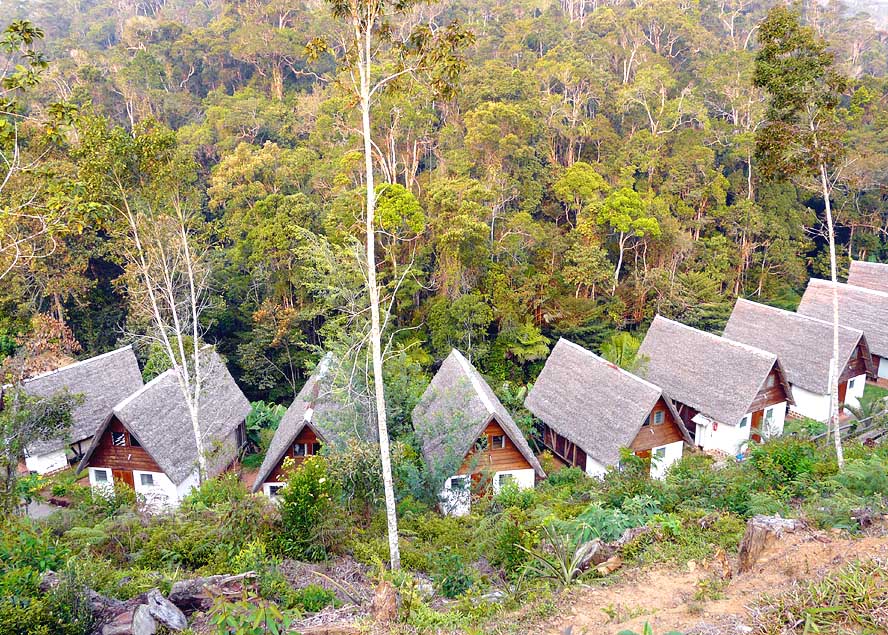
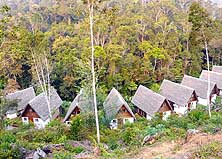
- 042
In our bungalow (6th from left)
- at the Hotel Feon’ny Ala in Andasibe
- each morning the “melancholy” call
- of the “Indri”, the biggest of the still
- living lemurs, is waking us up. Rarely
- did we feel closer to nature as during the
- day all of the tourists were “on tour”
|
-
- Andasibe-Antananarivo = 83 miles; 4.9 hours
After two nights we hit the road again. The capital Antananarivo, simply called
“Tana”, does not have a good reputation, we have not heard many positive things
about it. It is said to be an unsafe, dirty and smelly town with way too many cars, people
and beggars. No wonder that on this Wednesday afternoon we approach the “lion’s
den” with mixed feelings. Roadsigns are inexistant, our street map is inaccurate, and
we still do not use GPS. Therefore we have to ask once in a while a passers-by or even the
police for the right direction. “Are you giving me now something”, asks one of
the police officers trustfully after he showed us the way. After knowing that a traffic
policeman gains only around Aria 200’000, approx. US$ 100 a month, we give him some
little money – just because he asked so nicely.
|
-
-
|
-
-
-
-
|
-
-
|
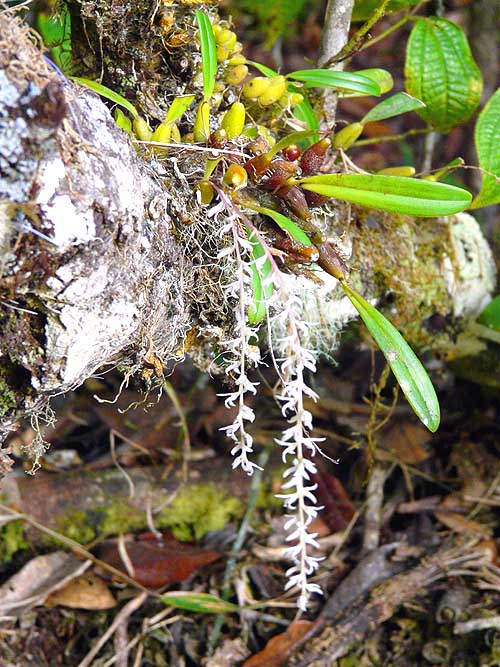
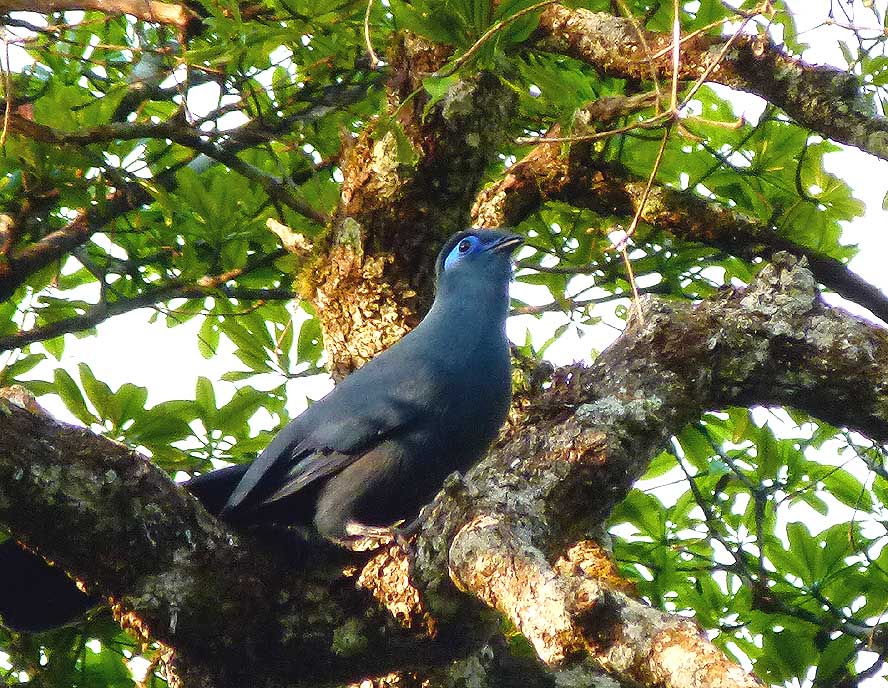
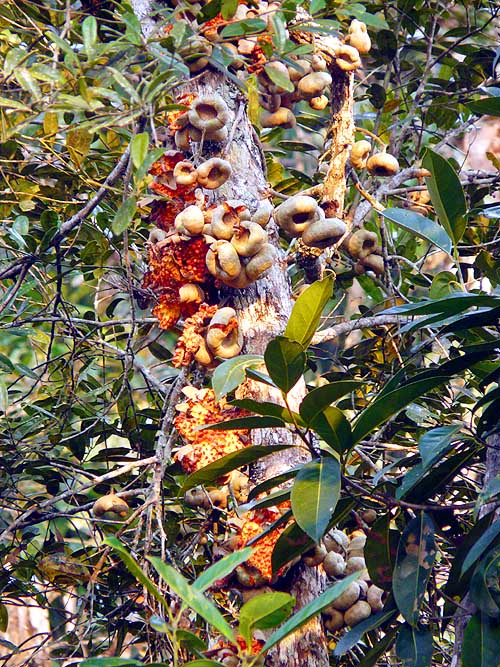
- Hidden “treasures” in the Mantadia National Park
|
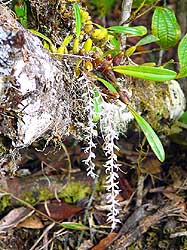
- 043
The delicate, dangling
- Bulbophyllum occlusum orchid
|
- 044
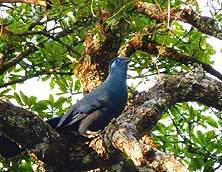
The “Blue Coua” bird
- (Coua caerulea)
|
- 045
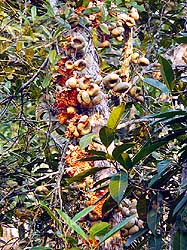
Fruits and seeds in their
- shiny orange colors
|
-
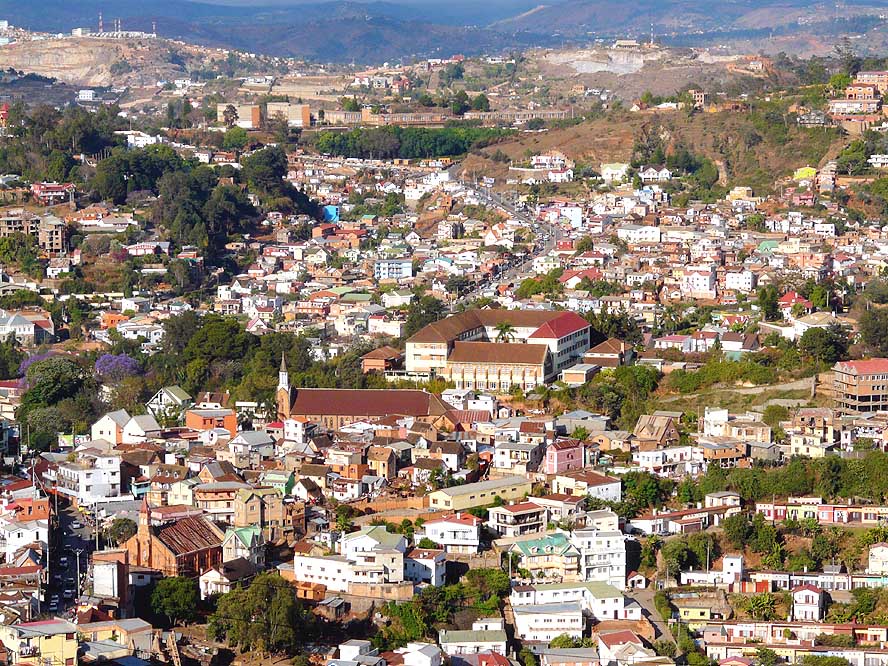
- Evening is approaching. On our drive into the city center the compact colorful sea of
houses between the hills gleams in a beautiful soft light – a lovely reception. We
booked a room in the Palm Hotel. The deciding factor was the offered secured parking.
Unfortunately we have to learn that “secured” parking here means: The car is
parked along the street in front of the hotel and should be guarded 24hours by a watchman.
Who believes it! On the campsites in Africa there was a joke
among travelers that if you need to go to the toilette during the night and stumble on
something – it is the sleeping watchman! Probably it would not be any better here.
What now? We almost give in to the inevitable when Emil sees by chance on his way
searching for some bread an illuminated sign of SICAM – of which he read once on the
internet that they have a secured parking area. It is only some minutes away from the Palm
Hotel. Why nobody mentioned it? The night costs Aria 5’000 (US$ 1.20); the day Aria
6’000. It is exactly a kind of place we used already when we were it in Hanoi in Vietnam.
|
-
-
|
-
-
|
-
-
|
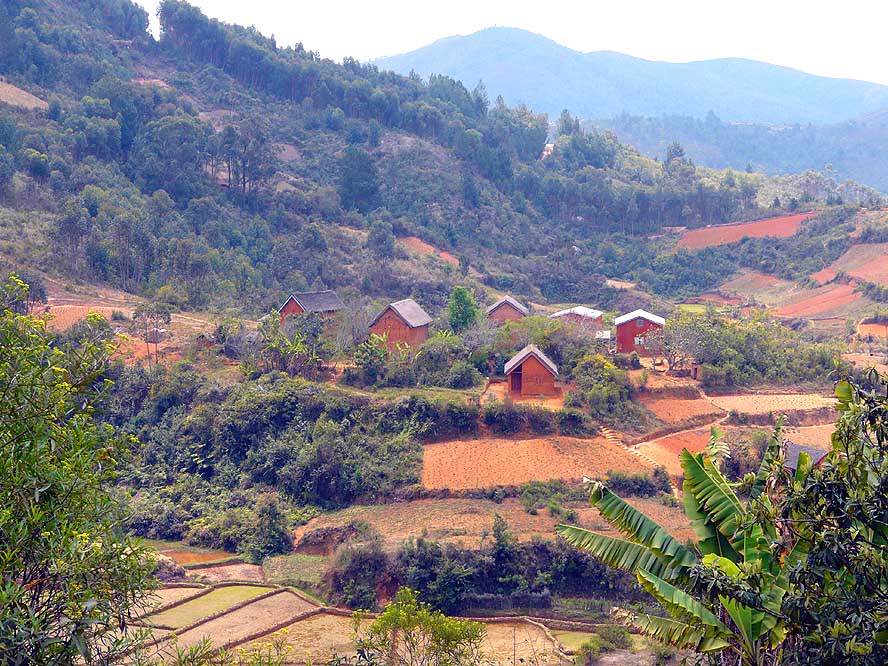
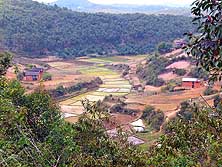
- 046
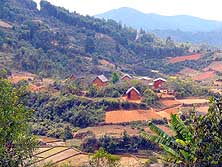
After the climb through the Mandraka
- Range between Andasibe and Antananarivo
- we are greeted on about 4’500 ft. by the
- typical Madagascan highland with its
- scattered dwellings made of red bricks
|
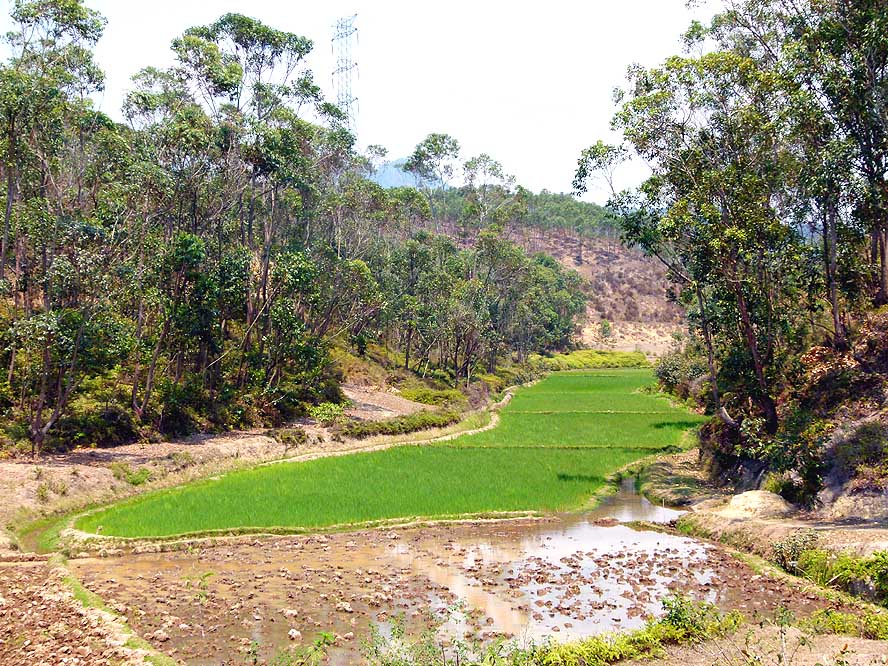
- 047
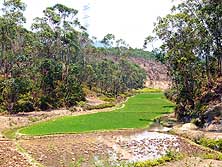
Every corner, every inch is used
- for planting rice. Rice is the main
- diet of the Madagascans
|
- 048
The neatly arranged rice
- fields demand hard work
|
-
- It is already dark when Emil is walking back from parking the car in the SICAM hall to
the hotel and suddenly is approached by youngsters. “The first one came on my left
side and begged with a hat. I did not pay much attention to it. Then a second one popped
up on my right side. That moment, my “alarm bells” started to ring. With
outstretched arm I turned around and hit a third guy that was behind my back. He fell on
the ground and the other two ran away”. Yes, the four years of African experience still have left its mark! Such small teenage
gangs exist unfortunately all over – particularly at tourist destinations. It
requires some alertness while walking the streets, mainly at night.
|
-
-
|
-
-
|
-
-
|
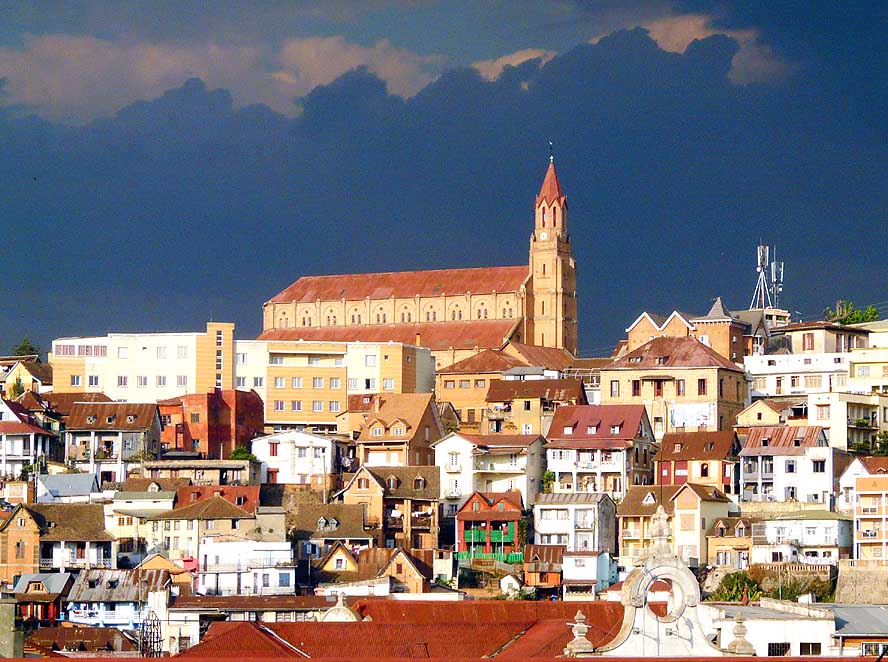
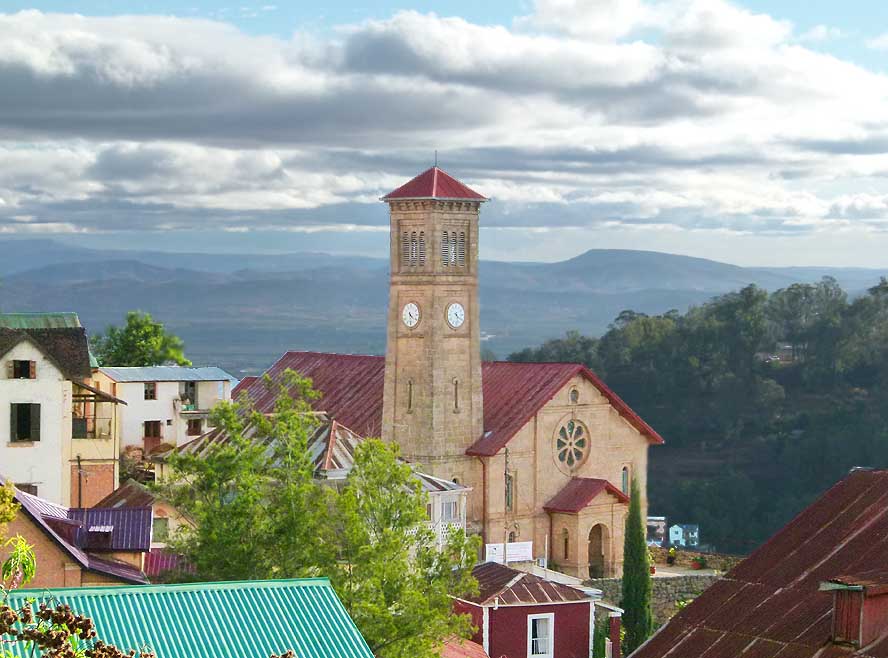
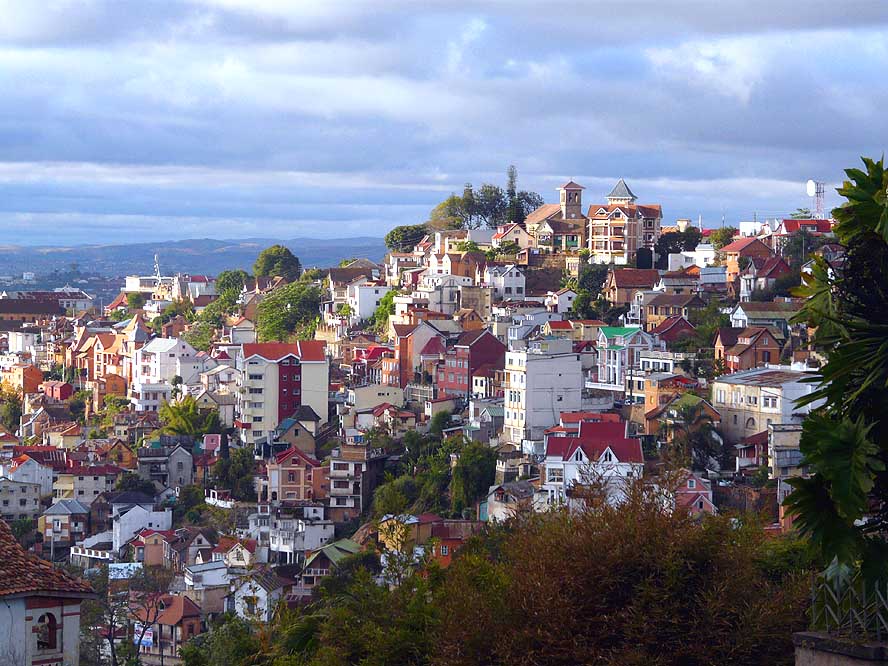
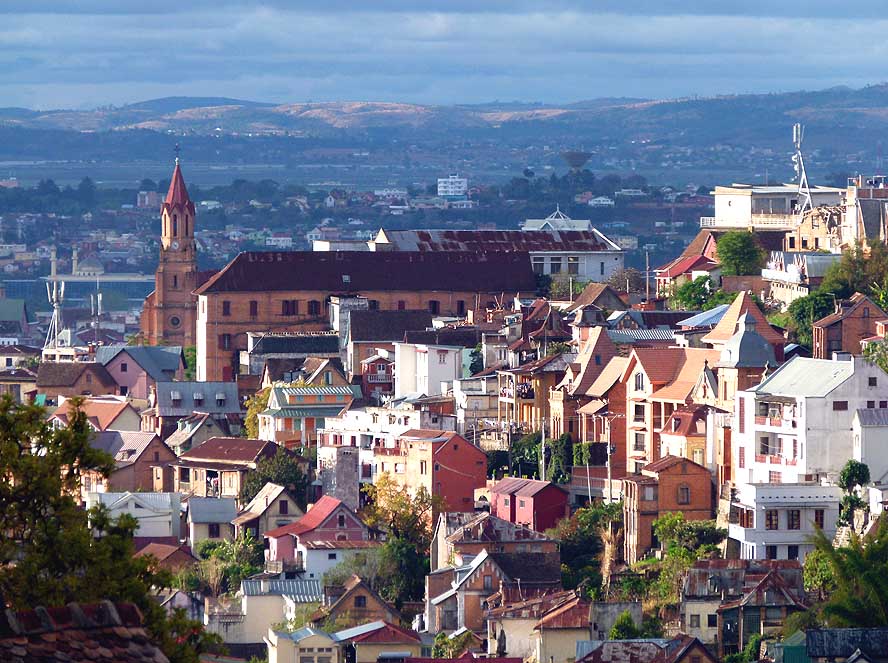
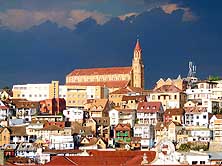
- 049
The capital Antananarivo – named
- shortly Tana – sits at an altitude of 4’183 ft.
- On arrival, it greets us with a beautiful
- evening glow. The ‘Eglise de Faravohitra’
- towers majestically from one of the 12
- (some talk even of 18) hills of the town
|
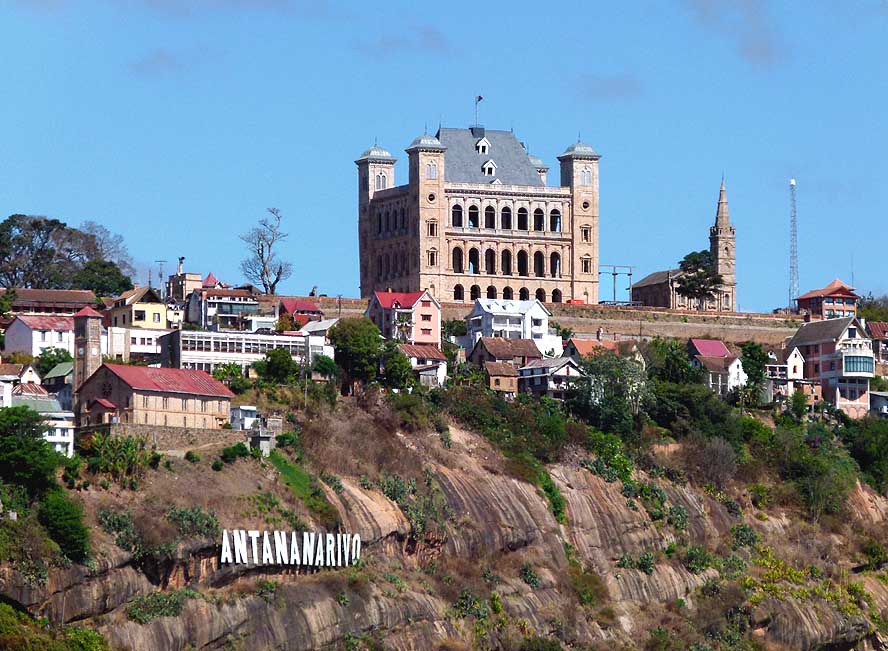
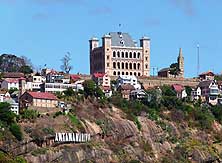
- 050
On the highest hill stands the most
- important building, the “Rova”, the royal
- palace. The interior is still closed to the
- public, but the views are superb. The
- building burnt down in 1995. The huge
- writing “Antananarivo” remembers
- somewhat Hollywood
|
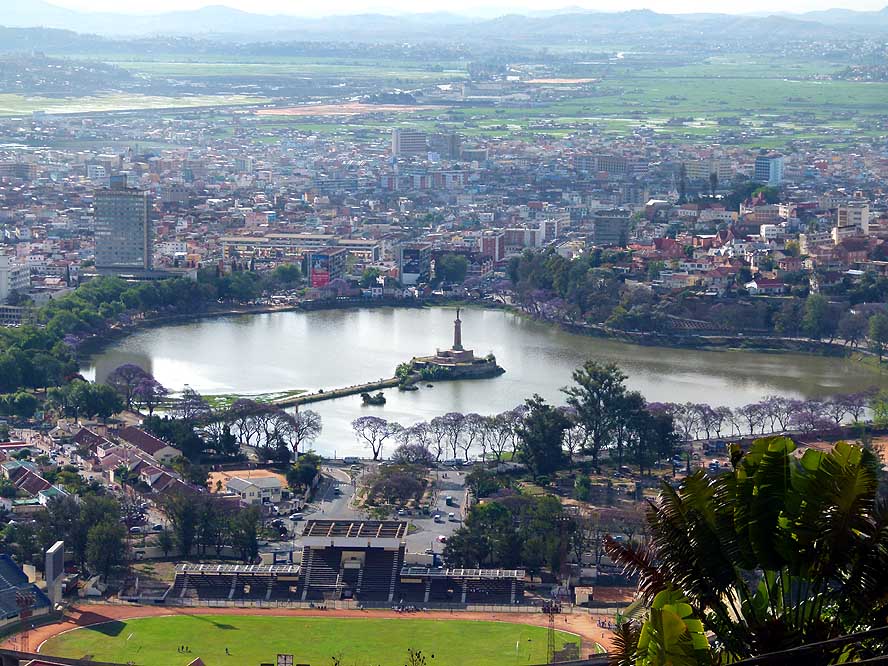
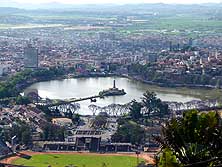
- 051
Particularly lovely is the sight
- over ‘Lac Anosy’ with its tree lined
- shore, surrounded by the dense sea
- of Tana’s houses
|
-
- Knowing the car to be safe and sound and having a lovely studio at the Park Hotel, we
feel more relaxed. After having expressed our gratefulness to the Ministry of Tourism and
our Embassy for assisting us regarding the difficult temporary import of our LandCruiser,
we start exploring the city. And we are pleasantly surprised: We like the place spread out
between the many hills despite all contrary predictions: The beautiful historic buildings,
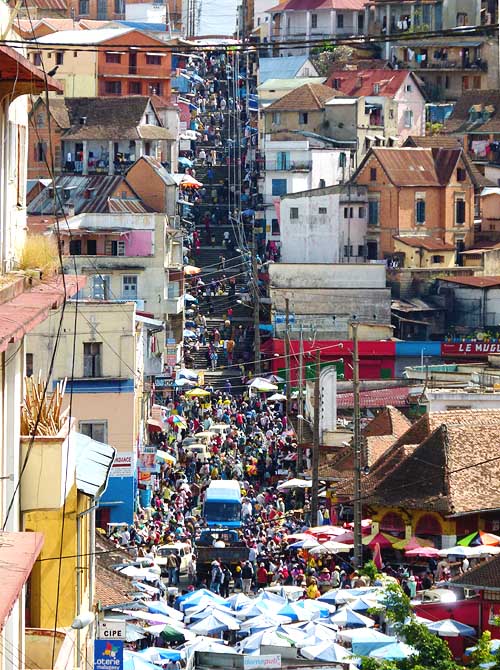
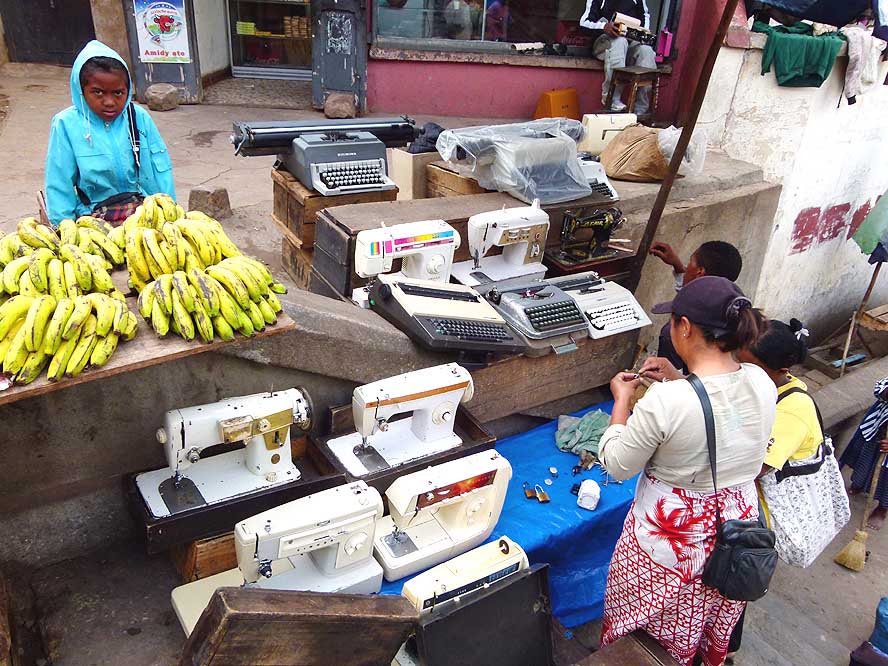
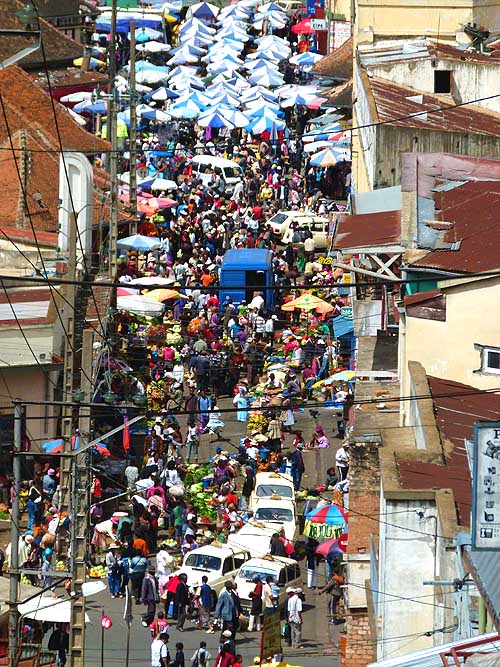
the towering hill churches, the unbeatable chaotic market hustle and bustle on the flight
of steep stairs where besides bananas, sun glasses, very old typewriters and
sewing-machines and many more antiques and oddities are on display.
|
-
-
|
-
-
-
-
|
-
-
|
- 052
Fascinating and unique: Northeasterly
- view to the Zoma market. On a flight of
- steep steps wedged into the city’s seamless
- sea of houses, everything imaginable and
- unimaginable is on display …..
|
- 053
….. old and nostalgic typewriters
- are sold next to old sewing machines
- and fresh bananas …..
|
- 054
….. View in Southwestern
- direction. The whole city center isn’t
- car-free at all – the whole transit
- traffic flows here
|
-
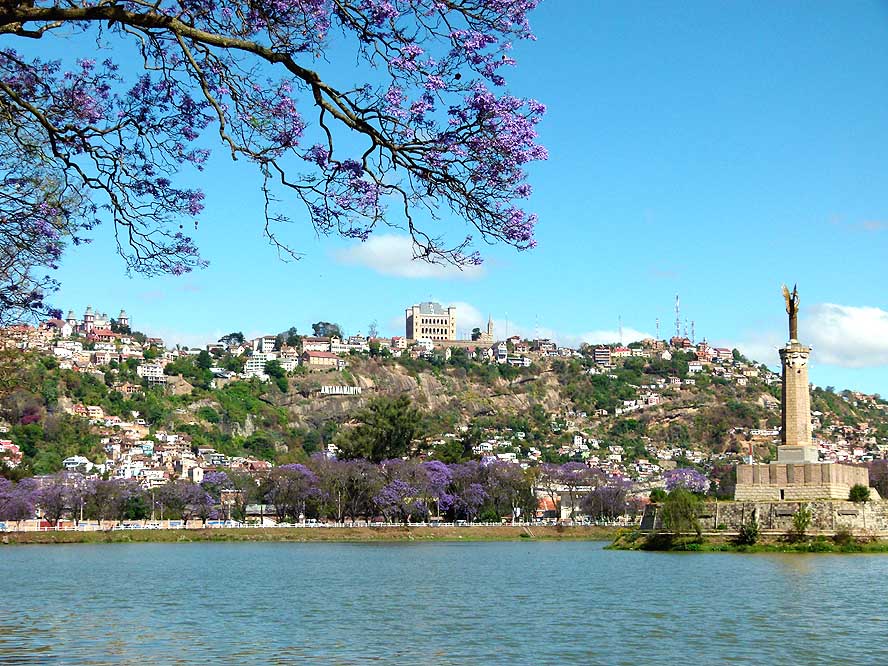
- We take a taxi to the “Rova”, the Kings Palace (the interior is still closed
for the public) topping the highest hill from where we enjoy a superb panorama over the
city and Lac Anosy, lined with flowering Jacaranda trees that bloom just now in October.
Next day we circle the lake under a deep blue sky and admire the view of the
“Rova” up the hill. We both agree: If we turn a blind eye to all the garbage
lying around, Antananarivo is an attractive, interesting and well worth seeing city. We
stay four days and enjoy it.
|
-
-
|
-
-
|
-
-
|
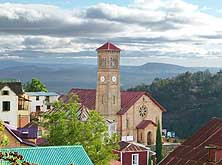
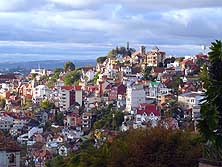
- 055
View towards the Northwestern city
|
- 056
The old venerable ‘Eglise
- d’Amboninampamarinana’ close to
- the ‘Rova” adorns one of the
- many hills of the city
|
- 057
Who says that Antananarivo
- is not an attractive city?
|
-
- Antananarivo-Antsirabe = 98 miles; 4.3 hours
On the fifth day, after 10am we are on the move again direction South. It is a Sunday. The
traffic is bearable and Emil catches straight away the right exit road. The big
supermarket chains of “Leader Price” and “Jumbo Score” are just few
miles outside of Tana and perfect for stocking up our cheese, sausage, beer and tonic
water (for our Gin Tonic) supplies. Afterwards it finally gets quiet and rural. We pass
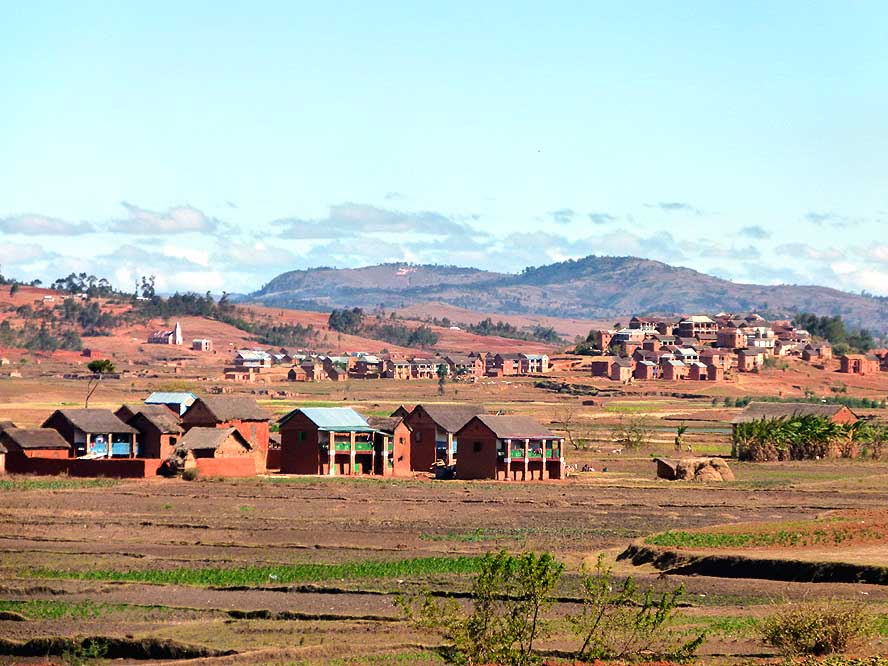
rolling hills and soon the first small scattered settlements with the red two-storey brick
houses of the Betsileo tribe come into view, harmonically embedded into the colors of the
high plateau. Today the skies are deep blue and the sight is very clear. It is a beautiful
drive.
|
-
-
|
-
-
|
-
-
|
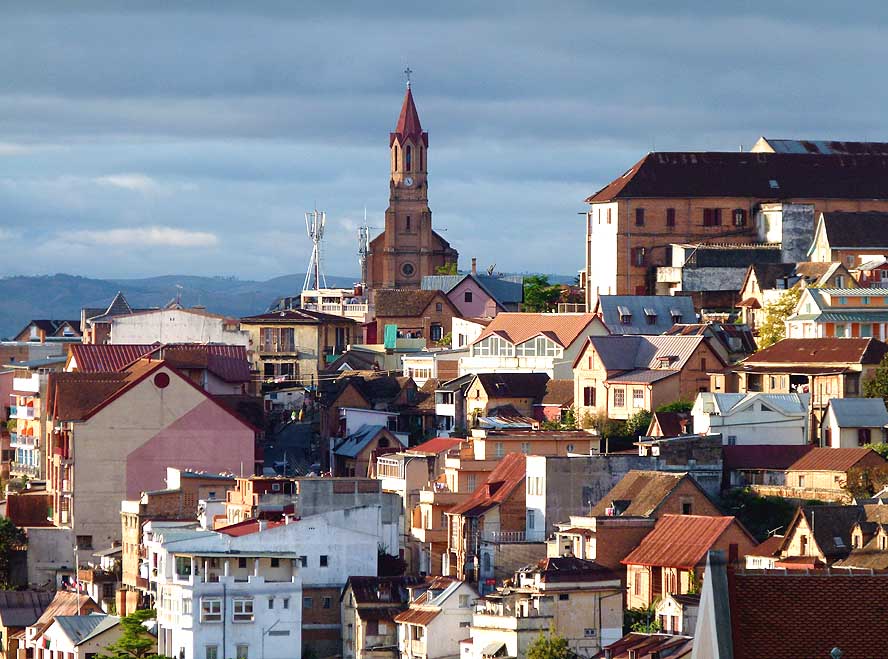
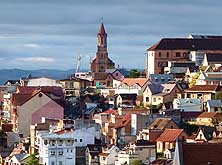
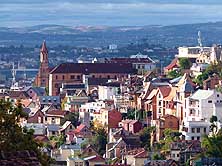
- 058
Townscape in the warm evening
- glow – once more with the church
- ‘Eglise de Faravohitra’
|
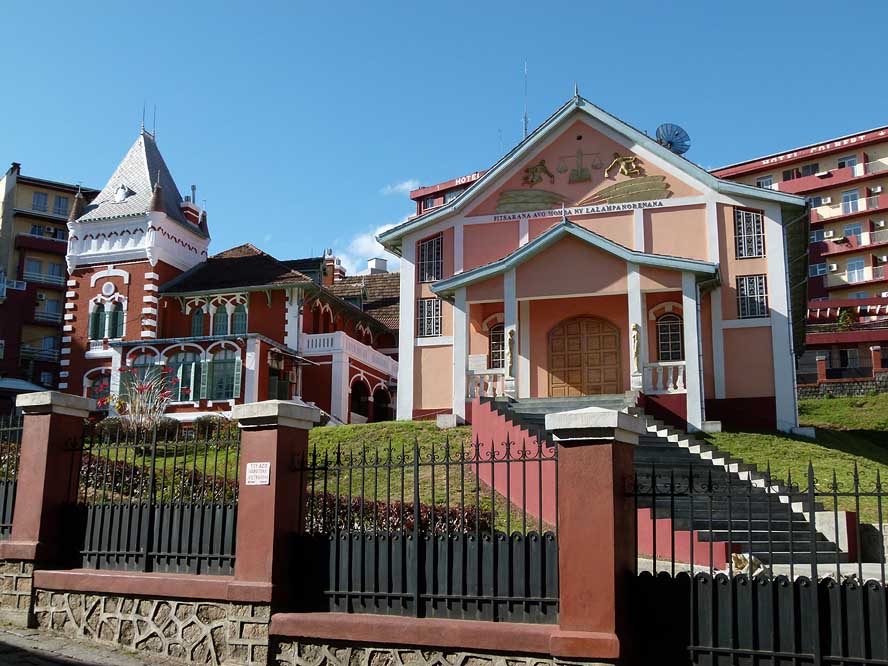
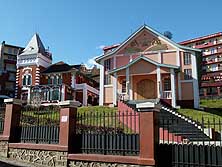
- 059
The two pretty buildings in the
- lawns are the Constitutional Court
- (Haute Cour constitutionnelle),
- situated below the Hotel Colbert
|
- 060
Wherever we look, churches rise
- over the roofs of the city. It’s said that
- there are 1’000 church towers
|
-
- After a 4,3 hours drive, we reach our today’s goal: The city of Antsirabe. With our
room at the Hotel Laville (Aria 46’000/US$ 21) for once we make a bad choice. An
ice-cold wind blows straight across the big gaps at the entry as well as the veranda door.
Despite of our own woolen blankets and thick clothing I shiver throughout the whole night.
We are at an altitude of nearly 4’000 ft.. Emil has a different problem: Bedbugs are
chasing him. Therefore we are both happy when it begins to dawn. Later we cash money from
an ATM and are “rolling” again, this time towards the West to the Baobabs in
Morondava on the Western coast.
|
-
-
|
-
-
|
-
-
|
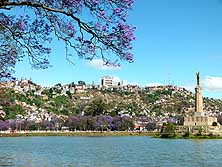
- 061
View from ‘Lac Anosy’ to the
- “Rova”, the royal palace on top of the
- hill. In the front (in the lake) is the
- memorial column dedicated to the fallen
- Madagascans in the two world wars
|
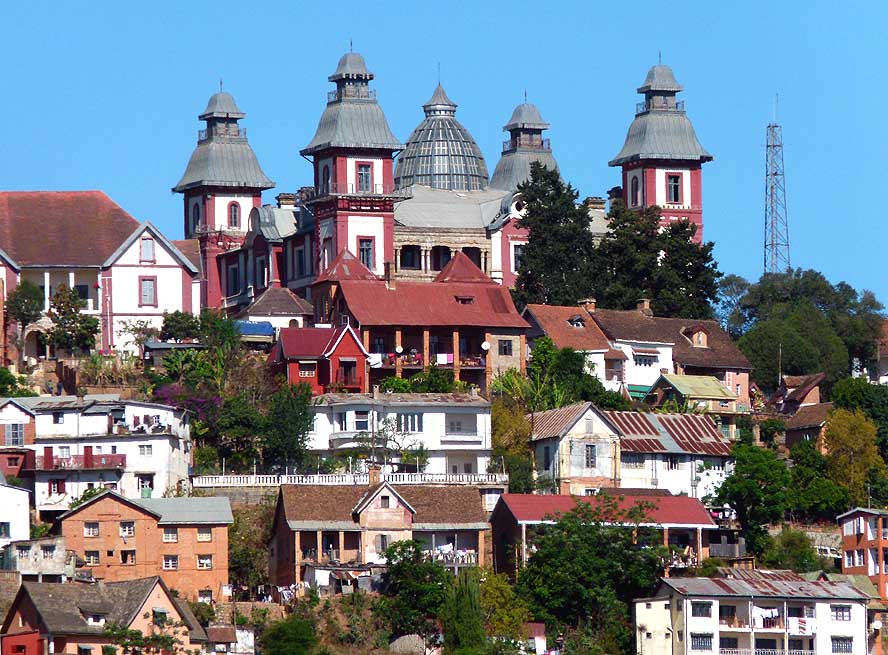
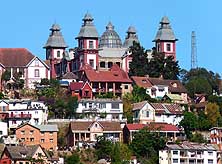
- 062
Until 1975 the “Palais
- d’Andafiavaratra” was the seat
- of former Prime Ministers.
- Then it burned down
|
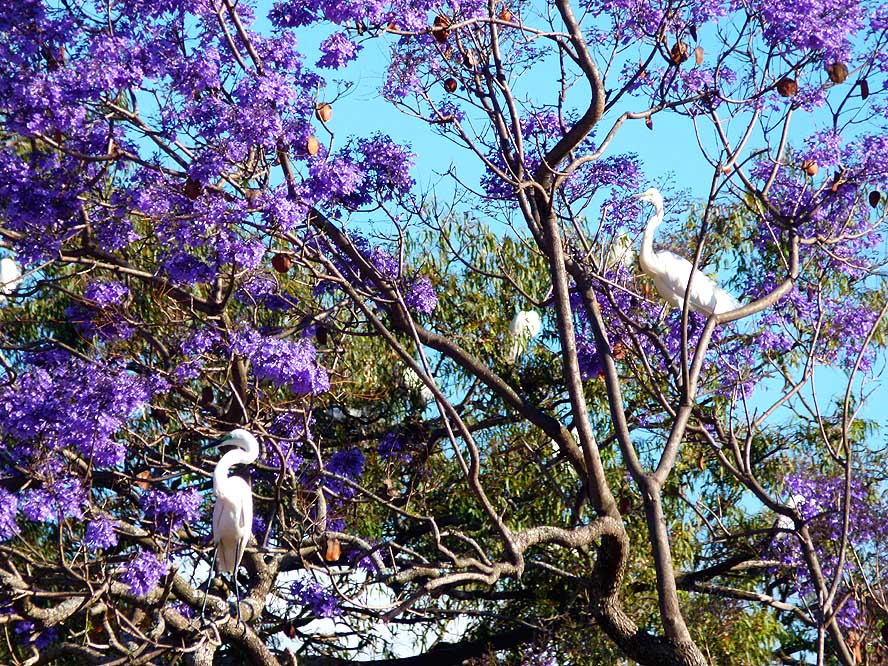
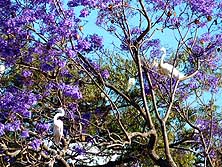
- 063
Egrets populate a blooming
- Jacaranda tree
|
-
- Antsirabe-Miandrivazo = 134 miles; 5.3 hours
We drive through a picture book landscape. The houses, the trees, the earth are a symphony
of a warm brown, green and yellow. Here a painter could put up his scaffold everywhere.
Suddenly it gets drier, the hills are bleak. The only attraction is now the vastness as
far as the eye can see and the great solitude. Most of the rice fields are not yet farmed.
Only where a river or a little brook is flowing through the land, they are sticking out in
their lush green.
|
-
-
-
-
|
-
-
|
-
-
-
-
|
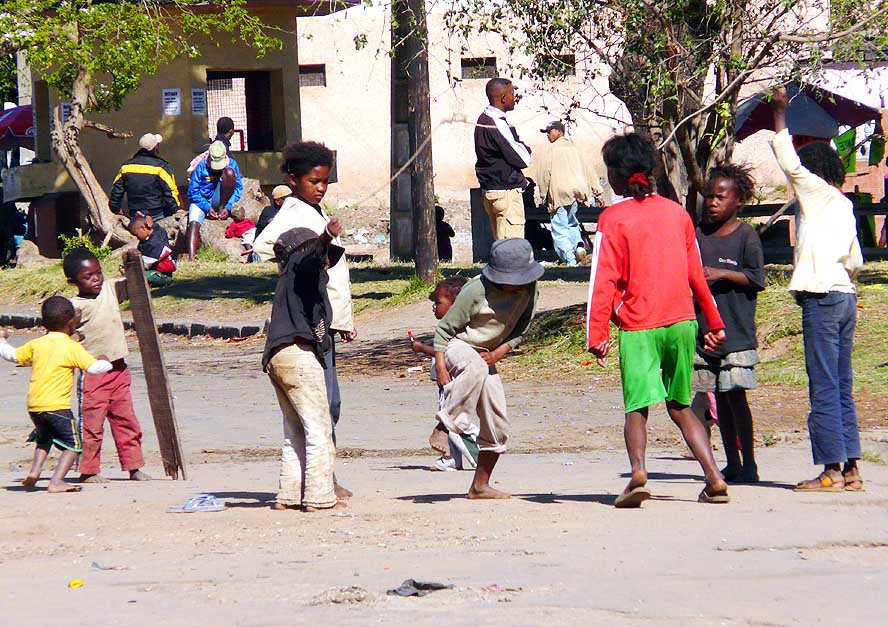
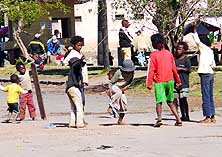
- 064
At the shore of ‘Lac Anosy’,
- children entertain themselves
- with jump roping
|
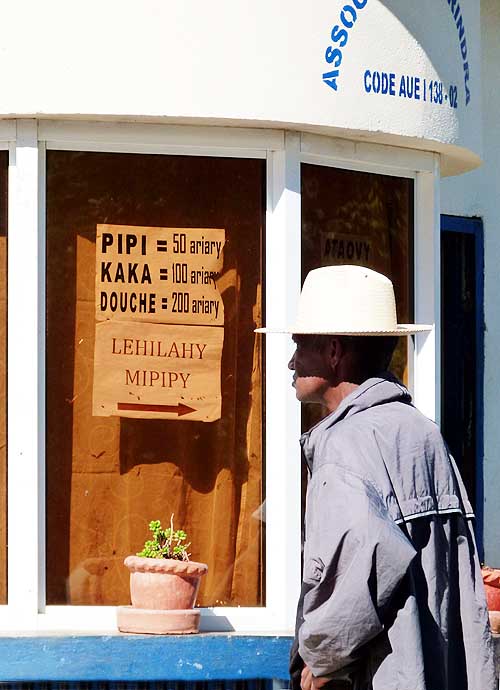
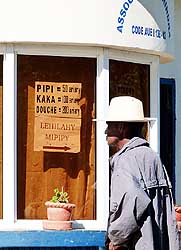
- 065
Sanitation at ‘Lac Anosy‘: These
- are the prices for nature's call or
- a shower (a shower costs 9 US¢)
|
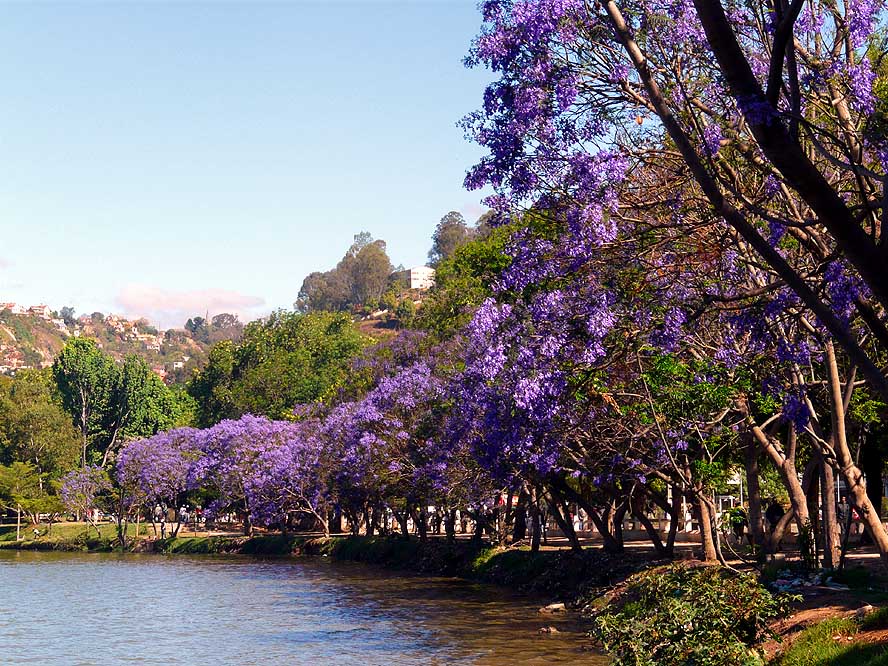
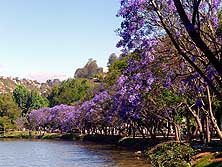
- 066
October: The Jacaranda trees
- at ‘Lac Anosy’ are in full bloom
|
-
- The black ribbon of the mostly good tarmac road continues meandering in never ending
bends through the mountains of the Central Highlands. Now and then we pass a peaceful
village with thatched houses, mostly beginning with the letter “A”. Usually, the
names are very long and complicated to pronounce, like e.g. “Ampasimadinika”.
Busy market life in big or small scale is taking place everywhere. Women are washing
wherever there is a puddle. Others are sitting on the sidewalk selling their vegetables.
At one occasion I think the girls are pounding millet – no, they are beating soil to
powder. Everywhere, our smile is returned heartedly, everywhere people wave at us. Despite
of their great poverty, the Madagascan people are cheerful and show a joy for life. They
are never intrusive. If we picnic close to the street, they just keep walking, making
traveling on this island very relaxed, at least in the own vehicle. However, the
“taxi-brousse” (bush taxis) are hopelessly overcrowded, leaving the Westerner
the only solution to hire a chauffeur-driven car, because self-drive vehicles are more
than rare to find.
|
-
-
|
-
-
|
-
-
|
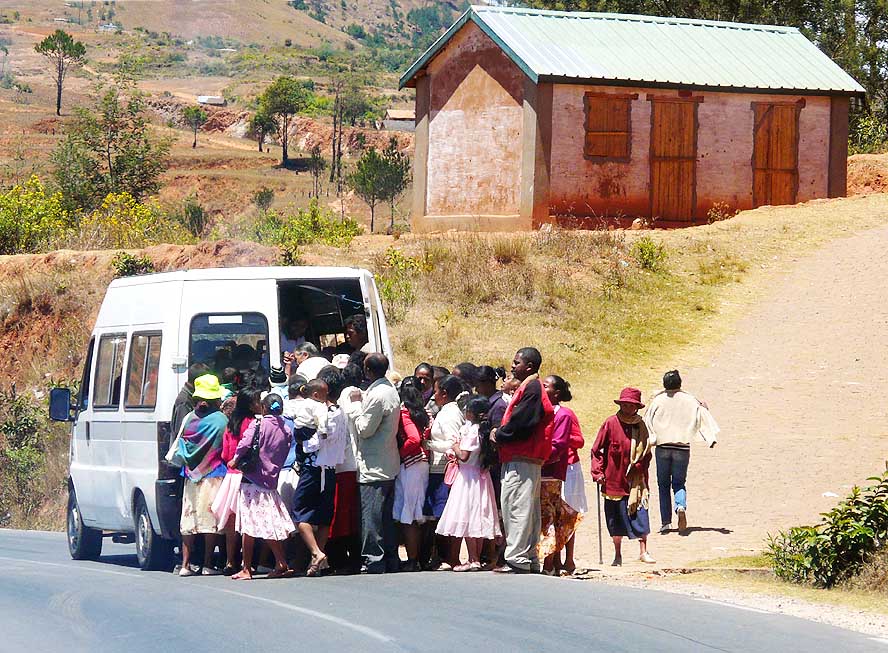
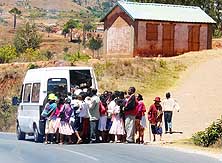
- 067
Will they all fit into the “taxi brousse”
- – the bush taxi? Probably they will! We
- are really happy to have our own
- mean of transport!
|
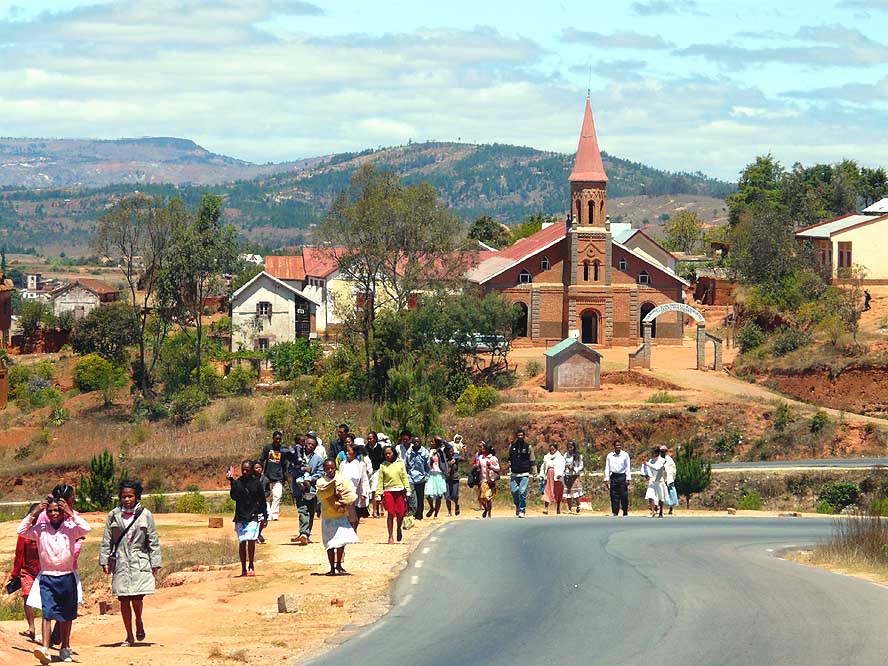
- 068
Neatly dressed church goers are
- on their way home from the Sunday
- mass. Madagascar’s population counts
- 20 millions, whereof 45% are Christians;
- 50% have their traditional religion
|
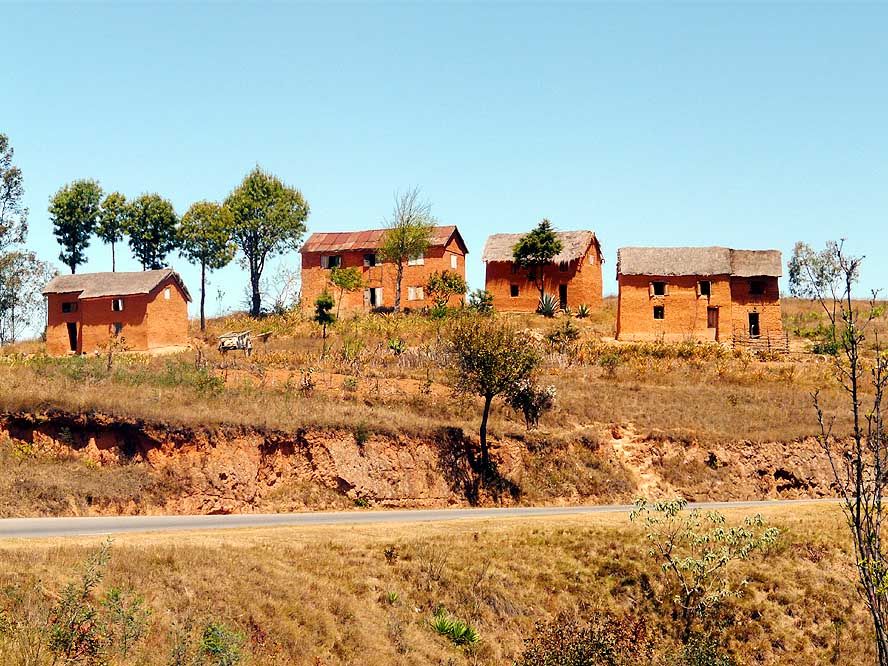
- 069
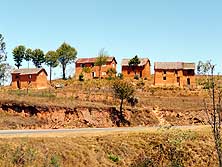
The double-storey red highland
- houses between Antananarivo and the
- 90 miles more Southerly town of
- Antsirabe fit wonderfully into the landscape
|
-
- After a potholed stretch we hear a familiar sound: It hisses and rumbles. We have a flat
tire – the first one since we mounted in July 2010 a new set of the Chinese brand
“Boto” in Jakarta in Indonesia. It is the 167th
of our tour around the world. At least, we are in
good company because every few miles truck or overcrowded bush taxi drivers lie under
their vehicles to fix something. B.t.w.: In cities most mechanics come directly to the
people’s houses for repairs. They mostly have neither a workshop nor space, only a
few tools. “Alone for the tools you carry with you, they would kill you here” a
Swiss mechanic in Colombia warned us once, many, many years back. Madagascar however
isn’t that bad – at least during daytime. Each time we change a tire, a funny
episode from India crosses our mind: It happened just outside a little village. Someone
spotted us and half of the village showed up to watch. Finally cars and busses stopped and
in the shortest of time the whole traffic came to a stand still because there was
something to see: A white guy changing a tire! But not here – some cars stop and ask
whether we need any help.
|
-
-
|
-
-
|
-
-
|
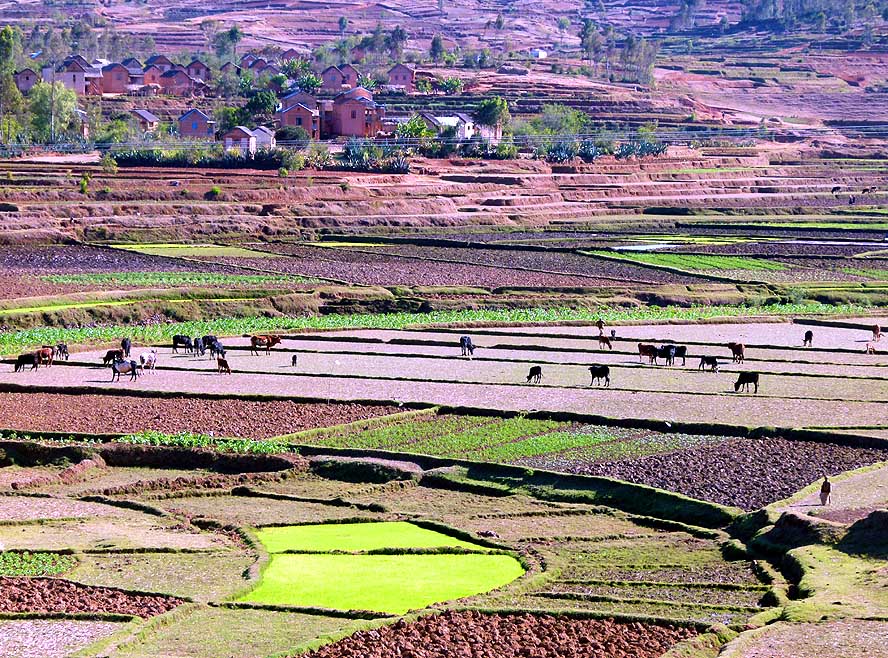
- 070
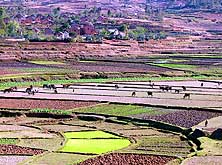
Still waiting for the rainy season to
- plant the rice. Meanwhile zebu herds search
- for some greens on the fallow fields.
- Normally the rain starts mid-November
|
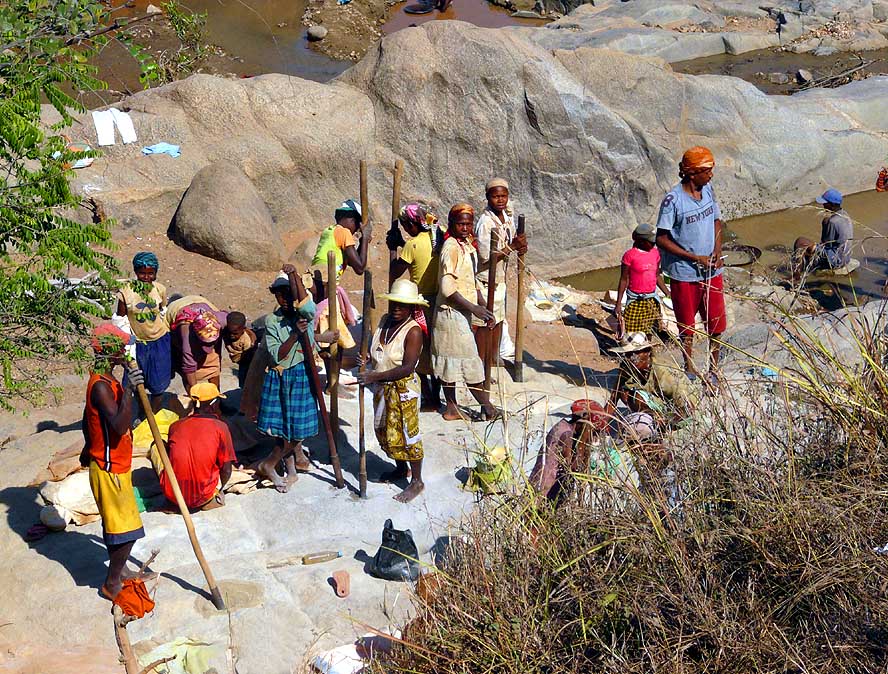
- 071
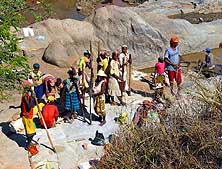
What are these people pounding?
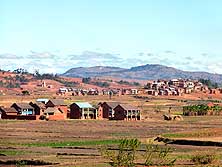
- After a closer look we see that it is not millet,
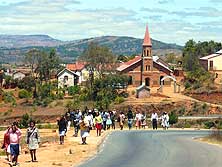
- but stones that they are refining to get sand
|
- 072
The villages that dot the highlands
- have all their distinctive architecture
- according to its ethnic groups, like here
- in the central highlands the Merina
|
-
- A few miles later, we reach Miandrivazo and are glad to be able to escape the crowds at
a place called “chez la Reine Rasalimo” situated on a quiet hill at the end of
the village. We are the only people at the outdoor restaurant, sipping a cold beer and
watching the sun setting with a beautiful glow. Unfortunately the night turns out to be
stiflingly hot because the fan in our bungalow is not working properly. And we are now at
the hottest place in Madagascar – says the statistic! With a lot of effort we are
able to download some emails with our 3G-USB-drive, not too bad if we consider where we
are.
|
-
-
|
-
-
|
-
-
|
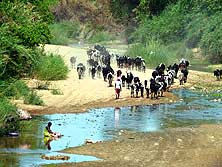
- 073
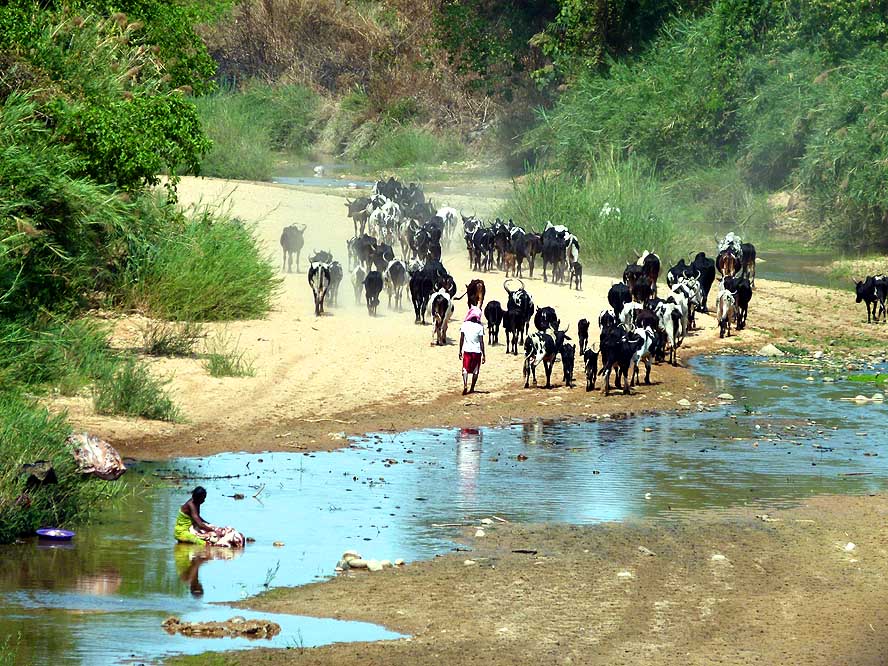
A herdsman leaves with his zebu herd
- the watering place, a woman does laundry.
- In the villages there is no running water. It
- has to be transported with jerry cans from
- a public water supply that mostly works
- only at certain times
|
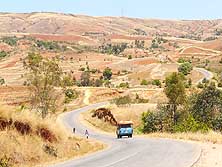
- 074
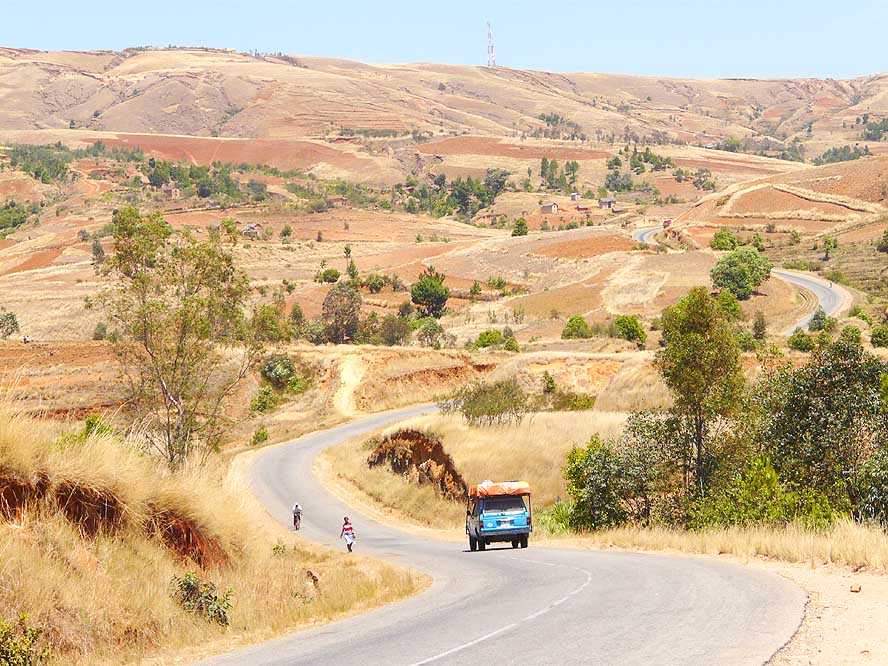
It is a pleasure to drive on the very
- good tarmac road through the hilly and
- almost traffic free highlands towards
- the West Coast at Morondava
|
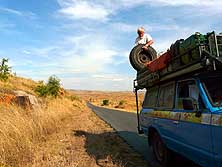
- 075
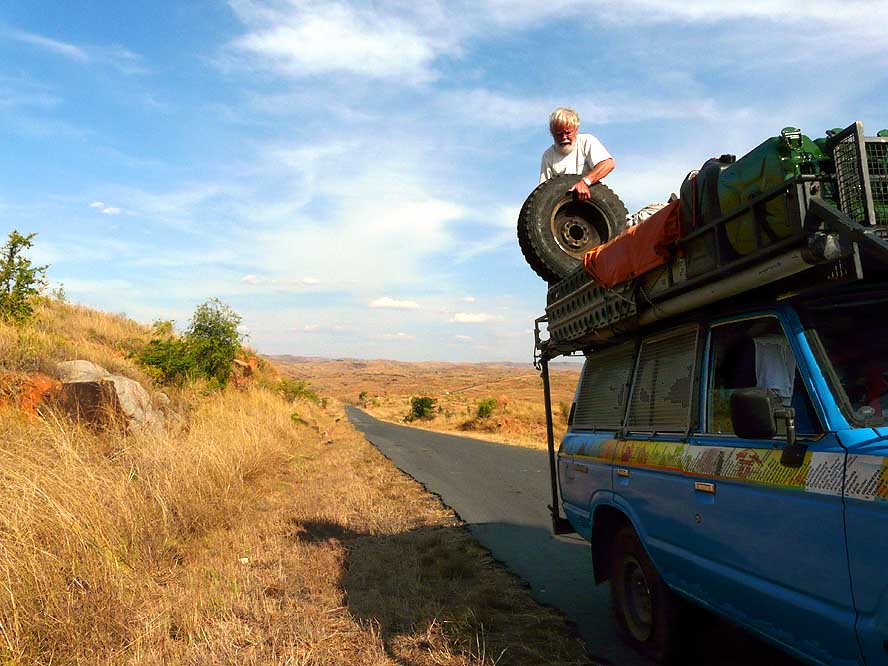
Short of Miandrivazo we have a flat
- tire – the 168th on our journey around
- the world and the first one since we
- bought 15 months ago new tires and
- tubes in Jakarta in Indonesia
|
-
|
| More websites
from Madagascar:
|
|